





ZBW 10KVA-4000KVA 3 مراحل IGBT مثبت الجهد الأوتوماتيكي الثابت للآلات عالية الدقة
مثبت الجهد الأوتوماتيكي المؤازر الأوتوماتيكي المؤازر ثلاثي الأطوار بقوة 150 كيلو فولت أمبير للتحكم في طاقة المصنع
مثبت الجهد الأوتوماتيكي المؤازر الأوتوماتيكي المؤازر للمعدات الميكانيكية SBW الصناعية الخارجية 100KVA 3 مراحل
مثبت الجهد المؤازر المؤازر SJW 3 مراحل 40KVA لمراكز البيانات التجارية
مقدمة
يمكن مثبتات الجهد improve power stability? Yes. An industrial voltage stabilizer can help maintain a more consistent voltage supply to factory equipment when the incoming voltage fluctuates within the unit’s specified operating range.
For manufacturers, this can reduce voltage-related equipment trips, control system resets, and production interruptions. However, a voltage stabilizer does not solve every electrical problem. It cannot provide backup power during an outage, correct an unstable power frequency, or eliminate harmonic distortion unless it is specifically designed for those functions.
The key is to identify the actual power problem before selecting equipment. Understanding the voltage variation, load characteristics, and operating conditions will help determine whether an industrial voltage stabilizer is the right solution.
1. What Does Power Stability Mean in a Factory?
In industrial environments, power stability refers to the ability of an electrical supply to provide suitable voltage, frequency, and power quality for connected equipment.
However, not all electrical problems have the same cause. A factory may experience voltage fluctuations throughout the day, short voltage dips when large motors start, or interruptions caused by an unstable power source.
Modern production facilities also use variable frequency drives (VFDs), PLCs, automated control systems, and precision machinery. These loads can interact with the electrical supply in different ways, making it important to distinguish voltage problems from other power quality issues.
Here are some common electrical conditions found in industrial facilities:
| Electrical Problem | Typical Cause | Can a Stabilizer Help? |
|---|---|---|
| Sustained low voltage | Heavy loading or feeder voltage drop | Yes, if within its input range |
| الجهد الزائد | Supply variations or incorrect transformer settings | Yes, if within its operating limits |
| Short voltage dips | Motor starting or switching events | Depends on duration and response speed |
| Power interruption | Grid failure or circuit breaker operation | No, backup power is required |
| التشوه التوافقي | Nonlinear loads such as VFDs | Not normally |
| Frequency variation | Unstable generator or power source | No, not with ordinary voltage regulation |
These conditions require different solutions. A voltage stabilizer is mainly designed to regulate voltage magnitude, not to correct every aspect of power quality.
2. How Does an Industrial Voltage Stabilizer Improve Voltage Stability?
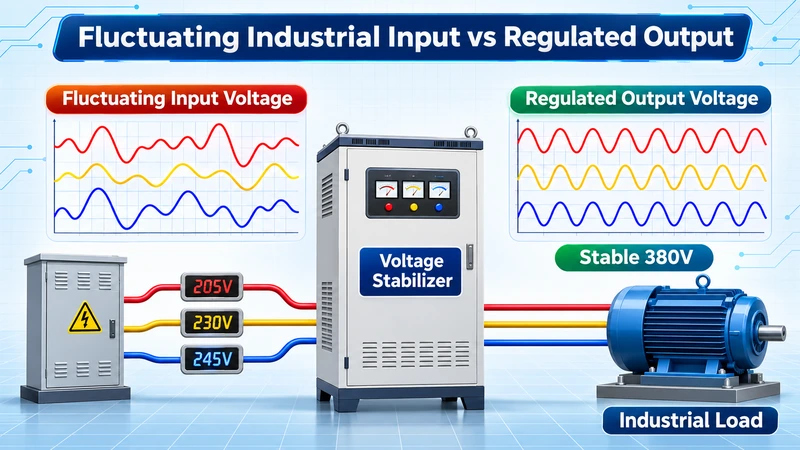
An automatic voltage stabilizer (AVR) monitors incoming voltage and adjusts its output toward a preset level. When the input voltage rises or falls, the control system activates the voltage correction mechanism to compensate for the variation.
The regulation method depends on the equipment design. Two common technologies are servo-controlled and static voltage stabilizers.
مثبت الجهد المؤازر
A مثبت الجهد المؤازر uses a motor-driven variable transformer or compensation mechanism to adjust voltage. It is commonly used in factories, workshops, and general industrial applications where voltage variations occur gradually or within a manageable operating range.
It can be suitable for production equipment that requires continuous voltage regulation, provided that the model has sufficient capacity and an appropriate correction range.
مثبت الجهد الساكن
A مثبت الجهد الساكن uses power electronic components, such as SCR or IGBT-based circuits, depending on its topology. It regulates voltage electronically without relying on the same mechanical adjustment mechanism used in conventional servo designs.
Static models are often considered for applications requiring faster voltage correction, including sensitive automation systems and precision industrial equipment. Actual response time and output accuracy must be confirmed from the manufacturer’s specifications.
A Simple Voltage Example
Consider a factory operating on a nominal 400V three-phase supply. Measurements at the proposed installation point show that voltage varies between 370V and 425V during normal production.
Compared with the nominal voltage:
- 370V represents approximately 7.5% below nominal.
- 425V represents approximately 6.25% above nominal.
If the connected machinery requires a stable 400V supply, an appropriately selected industrial voltage stabilizer may help correct these variations.
However, the stabilizer must support the full input range at the required load. Its capacity, output accuracy, correction speed, and protection settings must all be considered. These example measurements do not represent a universal stabilizer specification.
3. What Are the Main Benefits of an Industrial Voltage Stabilizer?
When voltage fluctuations are the main problem, an industrial voltage stabilizer can provide several practical benefits.
More Consistent Voltage for Industrial Equipment
Production machinery is designed to operate within specified voltage limits. When the incoming supply regularly moves outside those limits, equipment may experience alarms, abnormal operation, or unexpected shutdowns.
A correctly sized stabilizer helps maintain a more consistent output voltage, allowing connected equipment to operate under more suitable electrical conditions.
Reduced Risk of Voltage-Related Equipment Trips
Low or high voltage can cause certain motors, drives, control systems, and other electrical equipment to activate protective functions.
By correcting voltage variations within its operating range, a stabilizer may reduce trips caused specifically by unsuitable supply voltage. It will not prevent trips caused by mechanical overload, overheating, or other unrelated faults.
Better Operating Conditions for Sensitive Machinery
CNC machines, laser cutting equipment, laboratory instruments, and automated production systems may have specific input voltage requirements.
A dedicated voltage stabilizer can provide a more controlled supply for these loads when the existing distribution voltage does not consistently meet their requirements.
More Reliable Production Under Fluctuating Supply Conditions
Unexpected equipment shutdowns can interrupt production and require operators to restart machinery or inspect control systems.
Where voltage variation is the identified cause, stabilizing the supply may help reduce these interruptions. The actual improvement should be verified through operating records before and after installation.
4. When Does Voltage Regulation Help the Most?
Not every factory needs a voltage stabilizer. It is most useful when measurements show recurring voltage variations that affect equipment operation.
Sustained Voltage Fluctuations
Factories located at the end of long distribution feeders may experience voltage changes as electrical demand varies throughout the day.
If the voltage remains too high or too low for extended periods, an industrial voltage stabilizer may help maintain a suitable output for connected machinery.
Before installation, check whether the problem originates from transformer settings, undersized cables, or an overloaded distribution system. Correcting the underlying issue may be a better long-term solution.
Voltage Drops During Production
Some factories experience voltage drops when several machines operate simultaneously. Large compressors, pumps, and industrial motors can increase current demand and cause voltage drops across the supply network.
A stabilizer may help if the variation is within its correction capability. However, it cannot replace an undersized transformer or compensate indefinitely for insufficient power supply capacity.
Equipment with Narrow Input Voltage Requirements
Some production machines require a narrower voltage range than other factory loads. In this situation, installing a dedicated voltage stabilizer for the sensitive equipment may be more practical than regulating the entire factory supply.
The equipment manufacturer’s input voltage and ride-through requirements should always guide the selection.
5. What Problems Can a Voltage Stabilizer Not Fix?
Understanding the limitations of a voltage stabilizer is just as important as understanding its benefits.
- Power interruptions: A conventional stabilizer does not store energy. A UPS or generator is needed when equipment must continue operating during an outage.
- Harmonic distortion: Nonlinear loads, including some VFDs and rectifier systems, can introduce harmonics. A dedicated harmonic filter or other power quality solution may be required.
- Frequency instability: A voltage stabilizer does not normally correct variations between 50Hz and 60Hz or stabilize an unstable generator frequency. Source correction or a suitable frequency converter may be necessary.
- Low power factor: Voltage regulation does not replace power factor correction. Capacitor banks or static var generators (SVGs) may be considered after a proper load assessment.
- Electrical connection faults: Loose terminals, damaged cables, and neutral connection problems require inspection and repair by qualified electrical personnel.
- Short switching transients: Fast transient overvoltages may require properly selected surge protection devices (SPDs). An ordinary stabilizer should not be assumed to provide this protection.
- Phase imbalance: Some three-phase stabilizers support independent phase regulation, while others use linked regulation. The appropriate solution depends on the supply arrangement, load characteristics, and stabilizer topology.
In other words, a stabilizer should be selected to solve a clearly identified voltage problem rather than used as a general replacement for electrical system improvements.
6. Voltage Stabilizer vs. Other Industrial Power Protection Solutions
Different electrical problems require different equipment. The following comparison helps clarify where a voltage stabilizer fits into an industrial power protection system.
| Equipment or Solution | الوظيفة الرئيسية | التطبيق النموذجي |
|---|---|---|
| مثبت الجهد الكهربائي | Corrects high or low input voltage | Factories with recurring voltage fluctuations |
| Industrial UPS | Provides backup power and, depending on topology, voltage conditioning | Critical control systems and equipment requiring uninterrupted power |
| Surge Protection Device | Limits transient overvoltages | Protection against switching and lightning-related surges |
| Harmonic Filter | Reduces selected harmonic components | Facilities with significant nonlinear loads |
| Capacitor Bank or SVG | Provides reactive power compensation | Factories with power factor or reactive power issues |
| Frequency Converter | Converts or controls output frequency | Equipment requiring a different or controlled frequency |
For example, a factory with frequent voltage fluctuations but no power interruptions may benefit from voltage regulation. A data processing system that must remain online during a blackout needs a UPS instead.
In some facilities, these solutions may work together. The correct arrangement depends on the electrical problem, equipment requirements, and overall system design.
7. How to Decide Whether Your Factory Needs a Voltage Stabilizer
Before purchasing an industrial voltage stabilizer, follow a basic assessment process.
Step 1: Identify the Affected Equipment
Record which machines experience problems, when the faults occur, and what alarms appear. Check the rated voltage, frequency, and permitted input range in each equipment manual.
Step 2: Measure Input Voltage and Current
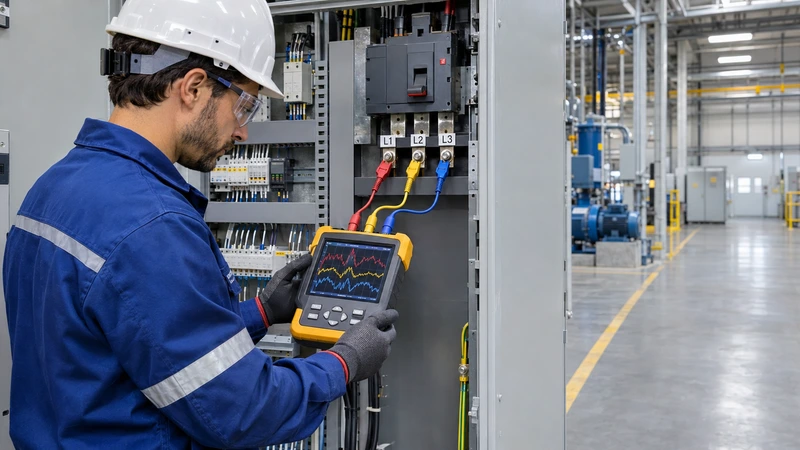
Use a suitable power quality analyzer or voltage data logger to monitor the electrical supply. Where practical, measure at the main incoming supply, the proposed stabilizer installation point, and the affected equipment.
Record all relevant phases, voltage, current, and event timestamps. Measurements should cover normal production shifts, peak loading periods, and motor starting cycles.
For more reliable monitoring, refer to IEC 61000-4-30, which defines measurement methods for power quality parameters including voltage magnitude, dips, swells, interruptions, frequency, unbalance, and harmonics.
IEEE 1159-2019 also provides guidance on power quality monitoring, measurement techniques, and interpretation of monitoring results.
Step 3: Check the Existing Electrical Distribution System
Inspect transformer capacity, cable sizing, connection conditions, phase balance, and load distribution. If the problem comes from an undersized feeder or faulty connection, repair it before adding voltage regulation equipment.
Step 4: Calculate the Required Stabilizer Capacity
Determine the total connected load and identify the largest motor starting current, peak demand, and expected operating duty.
Do not select a stabilizer based only on the total rated kW of the equipment. Power factor, starting current, load variation, and the stabilizer’s capacity at minimum input voltage must also be considered.
Step 5: Confirm the Technical Specifications
When requesting a quotation, provide the following information:
- Minimum and maximum measured input voltage.
- Required output voltage and permitted output tolerance.
- Single-phase or three-phase configuration.
- Total continuous load and peak load in kVA.
- Motor starting current and starting frequency.
- Operating frequency: 50Hz or 60Hz.
- Installation environment and ambient temperature.
- Required protection, bypass, and monitoring functions.
Ask the supplier to confirm the stabilizer’s operating range and available output capacity under the actual site conditions.
Step 6: Verify Performance After Installation
Repeat voltage measurements under comparable operating conditions. Compare the input and output voltage records and review whether the original equipment alarms or production interruptions have decreased.
This before-and-after assessment provides more useful evidence than relying on the stabilizer’s display alone.
8. Central Voltage Regulation vs. Dedicated Stabilizers
Factories can use either a central industrial voltage stabilizer or dedicated units for selected equipment groups.
Central voltage regulation supplies multiple loads from one stabilizer. It can simplify the electrical arrangement, but the unit must support the combined load, peak demand, and starting conditions. A failure or protection trip may also affect all connected equipment.
Dedicated voltage regulation supplies selected machines or production areas independently. It allows different loads to have different voltage requirements and can prevent unrelated equipment from influencing the sizing of one shared unit.
For example, a factory with large compressors and a sensitive CNC production line should not automatically connect both to the same stabilizer. The motor starting demand may determine the required capacity, while the CNC equipment may need a separate supply arrangement.
The final choice depends on load diversity, equipment criticality, maintenance access, bypass requirements, and installation cost.
9. What Should You Ask Before Buying an Industrial Voltage Stabilizer?
Before selecting a supplier, make sure the proposed model matches your actual operating conditions.
- What input voltage range can the stabilizer support at full load?
- Does the unit maintain its rated capacity at the minimum input voltage?
- What output voltage accuracy and response time can it achieve?
- Can it handle motor starting current and frequent load changes?
- What happens during overload, phase loss, and out-of-range input voltage?
- Does the model support independent phase regulation if required?
- Are bypass, remote monitoring, and customized protection available?
- Can the manufacturer provide technical drawings, test reports, and relevant certification documents?
These questions help buyers compare actual technical capabilities instead of relying only on advertised power ratings or output accuracy.
10. FAQ
Yes, but only in a specific way. A voltage stabilizer can improve the consistency of RMS output voltage within its operating limits. It does not automatically correct harmonics, frequency variations, power interruptions, or transient overvoltages. These issues require separate assessment and appropriate solutions.
The response depends on the specific model. Some units may provide limited regulation, while others transfer to bypass or shut down through protective functions. Always check the manufacturer’s documentation to understand how the equipment behaves during abnormal input conditions.
The response depends on the specific model. Some units may provide limited regulation, while others transfer to bypass or shut down through protective functions. Always check the manufacturer’s documentation to understand how the equipment behaves during abnormal input conditions.
الخاتمة
An industrial voltage stabilizer can improve factory voltage stability when the main problem is recurring high or low input voltage within a defined operating range. It can help maintain more consistent voltage for connected equipment and reduce problems associated with unsuitable supply voltage.
However, it is not a universal power protection solution. Before purchasing, identify the electrical problem, measure the actual voltage range, check the connected load, and compare the requirements with the stabilizer’s technical specifications.
في زينغشي إلكتريك, we manufacture مثبتات الجهد الصناعي and related electrical equipment for different industrial applications. Our product range includes مثبتات الجهد الأوتوماتيكية, three-phase voltage stabilizers, servo models, and static voltage regulation solutions.
Whether you need a stabilizer for a single production machine or a larger factory installation, our team can discuss the appropriate configuration and OEM/ODM requirements.
Contact ZHENGXI Electric with your input voltage range, equipment list, and load requirements to discuss an industrial voltage stabilization solution for your project.