




El mundo eléctrico global actual se enfrenta a problemas de compatibilidad de tensiones, especialmente en el uso de equipos extranjeros y la construcción de instalaciones industriales internacionales. El transformador reductor resulta esencial para garantizar que la electricidad suministrada a alta tensión pueda convertirse a baja tensión para evitar daños o derroches de energía.
Tanto si utiliza máquinas americanas con alimentación de 220 voltios como equipos industriales, es imprescindible seleccionar el transformador reductor de tensión adecuado.
En este artículo explicamos el funcionamiento de los transformadores reductores, sus aplicaciones y las consideraciones que hay que tener en cuenta a la hora de elegirlos.
¿Qué es un transformador reductor?
A transformador reductor es un dispositivo eléctrico que reduce la alta tensión de entrada a una tensión de salida más baja, manteniendo inalterada la frecuencia. Funciona según el principio de inducción electromagnética.
En términos sencillos:
👉 Entra alta tensión → Sale baja tensión.
Esto lo hace esencial para aplicaciones en las que los equipos deben funcionar a una tensión inferior a la de la fuente de alimentación disponible.
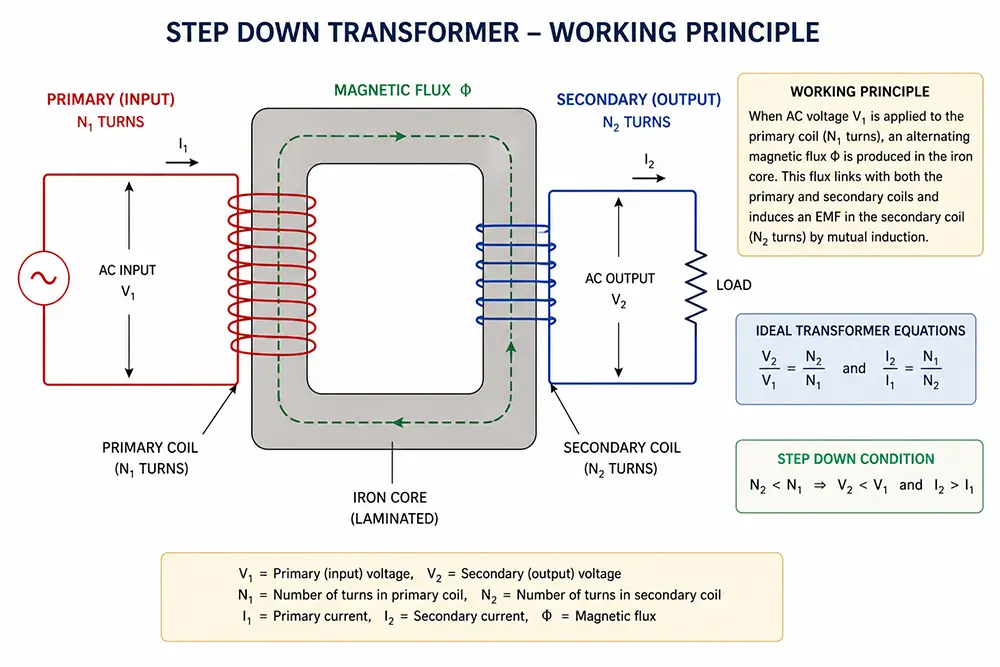
¿Cómo funciona un transformador reductor?
A transformador consta de dos bobinas principales:
- Bobinado primario (conectado a la tensión de entrada)
- Devanado secundario (conectado a la carga de salida)
La conversión de tensión depende del número de espiras de cada bobina:
V₁ / V₂ = N₁ / N₂
Dónde:
- V₁ = Tensión primaria
- V₂ = Tensión secundaria
- N₁ = Número de vueltas de la bobina primaria
- N₂ = Número de vueltas de la bobina secundaria
Si la bobina secundaria tiene menos vueltas que la primaria, la tensión de salida se reduce.
👉 Este sencillo pero potente principio permite a los transformadores ofrecer una conversión de tensión estable y eficiente sin cambiar la frecuencia.
Escenarios comunes de conversión de tensión
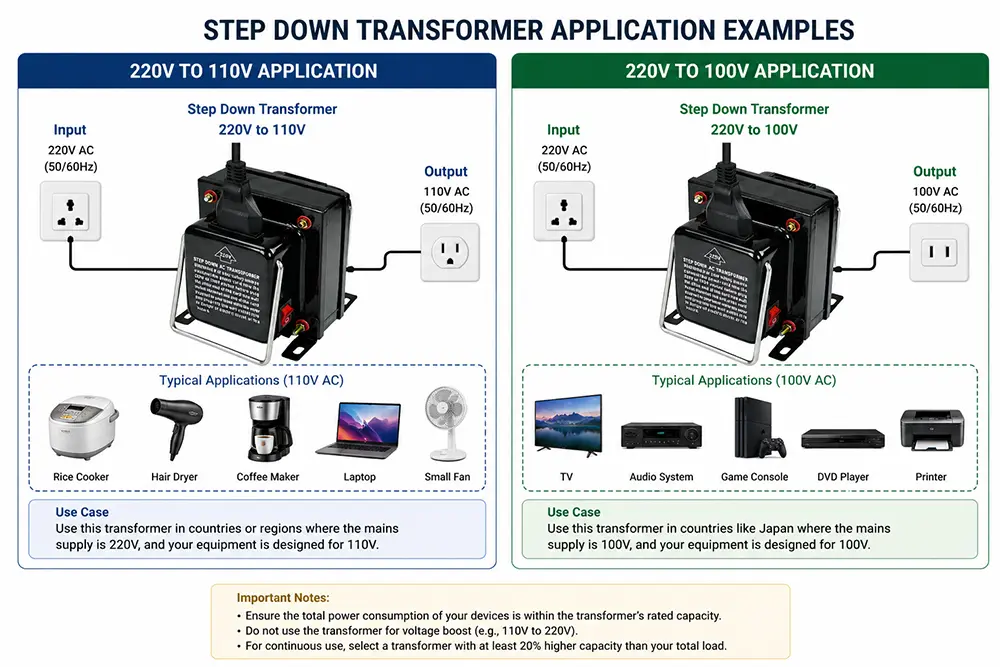
1. Transformador reductor de 220 V a 110 V
Uno de los escenarios más comunes en el mundo real es el uso de un Transformador reductor de 220 V a 110 V para hacer funcionar aparatos norteamericanos en países donde el voltaje estándar es de 220V-240V.
Casos de uso típicos:
- Electrodomésticos importados
- Material de oficina
- Electrónica de consumo
2. Transformador reductor de 220 V a 100 V
La electrónica japonesa suele funcionar a 100 V. Utilizando un Transformador de 220 V a 100 V asegura:
- Funcionamiento seguro
- Rendimiento estable
- Mayor vida útil de los equipos
Aplicaciones de los transformadores reductores
Los transformadores reductores se utilizan ampliamente en diferentes industrias:
Uso residencial
- Funcionamiento seguro de los aparatos importados
- Protección de componentes electrónicos sensibles
Aplicaciones industriales
- Máquinas CNC
- Equipos de fabricación
- Paneles de control y sistemas de automatización
Infraestructura comercial e informática
- Centros de datos
- Equipamiento médico
- Sistemas de oficina
Sistemas de energía renovable
- Sistemas de energía solar
- Integración en la red y regulación de la tensión
👉 Los principales proveedores de soluciones eléctricas hacen hincapié en la gestión adecuada de la tensión como factor clave para la eficiencia energética y la protección de los equipos.
Especificaciones técnicas que debe conocer
Antes de elegir un transformador, es importante conocer estos parámetros clave:
- Tensión de entrada: por ejemplo, 220V / 240V
- Tensión de salida: por ejemplo, 110V / 100V
- Potencia nominal (VA o kVA): Debe superar la carga total en 20-30%
- Frecuencia: Compatibilidad 50Hz o 60Hz
- Eficacia: Normalmente 95%-98%
- Método de refrigeración: Refrigerado por aire o por aceite
Transformador reductor frente a convertidor de tensión
| Característica | Transformador reductor | Convertidor de tensión |
|---|---|---|
| Eficacia | Alta | Moderado |
| Durabilidad | Larga vida útil | Corta vida útil |
| Capacidad de carga | Alta | Limitado |
| Estabilidad de la producción | Muy estable | Puede fluctuar |
| Aplicación | Uso industrial y continuo | Viajes y trabajos ligeros |
👉 Conclusión: Si necesita un rendimiento fiable a largo plazo, un transformador es siempre la mejor opción.
Transformadores reductores frente a otros tipos de transformadores
Transformador reductor frente a transformador elevador
- Reductor: Reduce la tensión (220V → 110V).
- Step Up: Aumenta la tensión (110V → 220V).
Transformador de aislamiento
- Sin cambio de tensión
- Se utiliza para reducir la seguridad y el ruido
Autotransformador
- Diseño de bobinado único
- Más pequeño y eficiente, pero con menos aislamiento
Cómo elegir el transformador reductor adecuado
Elegir el transformador adecuado es fundamental para la seguridad y el rendimiento.
1. Calcular la carga total
Sume la potencia de todos los dispositivos y elija un transformador con una potencia nominal mínima de 20-30% superior.
2. Confirme los requisitos de tensión
Asegúrese de que se ajusta exactamente a sus necesidades:
- 220 V → 110 V
- 220 V → 100 V
3. Considerar el entorno
- Instalación interior o exterior
- Temperatura y humedad
4. Comprobar los dispositivos de seguridad
Busca:
- Protección contra sobrecargas
- Protección contra cortocircuitos
- Protección térmica
5. Evaluar la calidad de la construcción
Los transformadores de alta calidad suelen utilizar:
- Bobinados de cobre
- Materiales aislantes resistentes
- Carcasas metálicas duraderas
Factores de precio de los transformadores reductores
El precio de un transformador reductor depende de varios factores:
- Potencia (VA/kVA)
- Bobinados de cobre frente a bobinados de aluminio
- Tipo de refrigeración (en seco o con aceite)
- Requisitos de personalización
👉 Los transformadores industriales cuestan más, pero ofrecen una durabilidad y un rendimiento mucho mejores.
Ventajas de los transformadores reductores
- Alta eficiencia con baja pérdida de energía
- Tensión de salida estable
- Apto para funcionamiento continuo
- Larga vida útil
- Amplia gama de aplicaciones
Limitaciones
- Mayor tamaño que los convertidores electrónicos
- Mayor coste inicial
- Mayor peso
Sin embargo, a menudo se trata de concesiones aceptables a cambio de una mayor fiabilidad y seguridad.
Futuras tendencias de desarrollo
El sector de los transformadores evoluciona rápidamente con innovaciones como:
- Tecnología de transformadores inteligentes
- Sistemas de supervisión basados en IoT
- Materiales aislantes ecológicos
- Diseños más compactos y eficientes
👉 Se espera que la digitalización mejore significativamente el rendimiento, la supervisión y el mantenimiento en los próximos años.
FAQ
No siempre. Asegúrese de que la capacidad del transformador supera la potencia de su aparato. Los equipos sensibles también pueden necesitar estabilización de tensión.
Un transformador está diseñado para un uso estable a largo plazo, mientras que un convertidor suele ser para aplicaciones a corto plazo o de viaje.
Sí, siempre que el voltaje y la potencia nominal coincidan con los requisitos del dispositivo.
Debe elegir un transformador con una potencia nominal mínima de 20-30% superior que su carga total.
Sí. Los transformadores de alta calidad están diseñados para un funcionamiento continuo, especialmente en entornos industriales.
¿Por qué elegir un fabricante profesional de transformadores?
Elegir al proveedor adecuado es tan importante como elegir el propio transformador.
A fiable fabricante de transformadores puede proporcionar:
- Soluciones de tensión personalizadas (de 220 V a 110 V, de 220 V a 100 V, etc.)
- Rendimiento estable y eficiente
- Bobinado de cobre de alta calidad
- Asistencia OEM/ODM para aplicaciones industriales
Para necesidades a gran escala o personalizadas, trabajar directamente con un fabricante experimentado garantiza un mejor control de la calidad y una mayor rentabilidad.
También le puede interesar:
- soluciones de transformadores a medida
- estabilizador de servotensión
- estabilizador de tensión industrial
Conclusión
A transformador reductor es esencial para una conversión de tensión segura y eficaz en aplicaciones residenciales, comerciales e industriales.
Tanto si necesita un 220 V a 110 V o 220 V a 100 V seleccionar las especificaciones y el proveedor adecuados marca la diferencia.
👉 ¿Busca un transformador reductor fiable y de alto rendimiento?
Ofrecemos soluciones de transformadores personalizadas adaptadas a sus necesidades exactas de tensión, capacidad y aplicación. Póngase en contacto con nosotros hoy mismo para obtener asistencia experta y precios competitivos.
