




Voltage instability is still a daily occurrence in many areas of Southeast Asia and Africa. In countries like Kenya, Nigeria, Philippines, Indonesia, grid fluctuation, load shedding, poor quality transformers, and generator switchings cause voltage swings that destroy household appliances.
In medium to large homes in these countries, a whole house voltage stabilizer would be a more reliable and cost-effective option in the long run, although individual appliance voltage stabilizers would still be a good option under particular circumstances.
This document aims to offer a technical, economic, and practical comparison, specifically for grid conditions that prevail in emerging countries.
Understanding Voltage Instability in Emerging Power Grids
As per the power quality standards defined in the guidelines of the Institute of Electrical and Electronics Engineers, a deviation of voltage beyond ±10% for a prolonged period can lead to a reduction in motor life.
The normal conditions of the grid in developing countries are as follows:
- Undervoltage during evening peak hours
- Overvoltage during low load hours of the night
- Rapid changes in voltage due to diesel generator sets
- Voltage dips due to weak and over-loaded transformadores de distribución
The Indian Electrical and Electronics Manufacturers’ Association has pointed out an increasing trend in the demand for residential voltage regulation products.
If not regulated, the equipment can suffer the following failures:
- Burnt compressor motor of air conditioning and refrigeration equipment
- Flickering of the lighting systems
- Failure of the PCB of washing machines
- Damaged power board of televisions
- Premature failure of borehole water pumps
In the long term, an unsteady voltage supply not only leads to equipment failure but also reduces its lifespan.
What Is a Whole House Voltage Stabilizer?
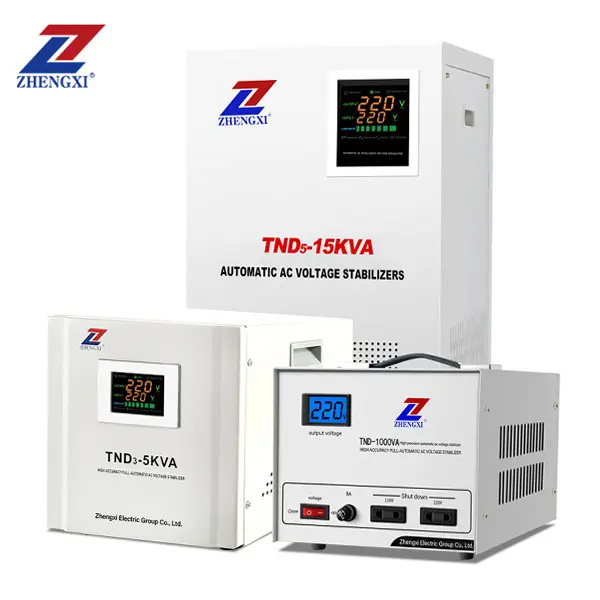
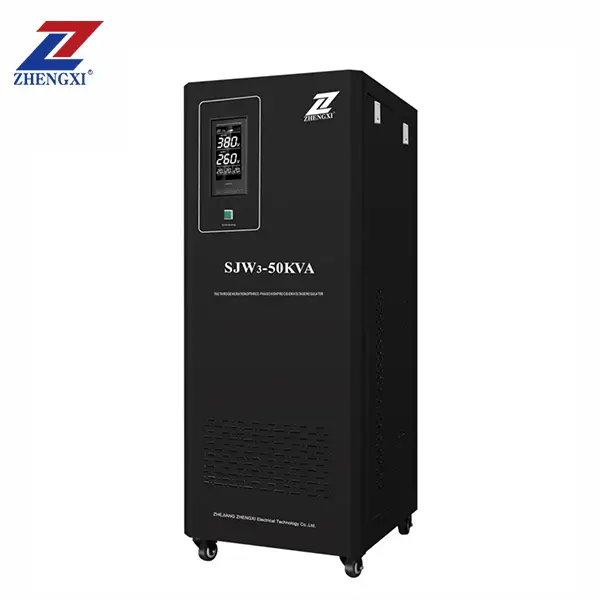
The whole-house voltage stabilizer, also known as a central AVR and a residential voltage regulator, is usually located in the main distribution board. It regulates the supply voltage before it reaches the branch circuits.
Key Technical Characteristics
Capacity Range: 1kVA – 60kVA+
Single-Phase/Three-Phase: Available in both configurations
Output Accuracy: ±1% – ±3%
Efficiency: 95%-98%
Automatic Real-Time Voltage Correction
Overload and Short Circuit Protection

Principio de funcionamiento
The most common types of voltage stabilizers for residential use are:
Servo Motor-Controlled Transformers
Rentable
Durable
Suitable for Large Voltage Fluctuation Ranges of ±20 – 30%
Fast Response Time
No Moving Parts
Suitable for Sensitive Electronics
In Africa and Southeast Asia, servo motor-controlled voltage stabilizers are the most preferred. This is because they can handle extreme fluctuation ranges and environmental conditions.
What Are Individual Appliance Stabilizers?
Individual stabilizers are plug-and-play devices connected between a wall outlet and a single appliance.
Common applications:
- Aire acondicionado
- Frigoríficos
- Televisions
- Freezers
- Water pumps
Typical rating: 0.5kVA – 5kVA
They are affordable and require no professional installation, making them popular in rental properties and small households.
Technical Comparison: Central vs. Individual Protection
| Factor | Whole House Stabilizer | Individual Stabilizers |
|---|---|---|
| Protection Coverage | Entire home | One appliance |
| Instalación | Professional | Plug-and-play |
| Capacidad | 1–60kVA+ | 0.5–5kVA |
| Long-Term Cost | Lower (3+ devices) | Higher if multiple units |
| Mantenimiento | One unit | Multiple devices |
| Voltage Uniformity | Consistent across circuits | May vary |
| Future Expansion | Easy | Requires new unit |
Real Cost Scenario (Emerging Market Example)
Consider a typical household:
Appliances:
- 1 Air Conditioner (2kVA)
- 1 Refrigerator (1kVA)
- 1 Washing Machine (1kVA)
- 1 Television (0.5kVA)
Option A: Individual Stabilizers
- 4 units × $35 average = $140
- Adding freezer or water pump? +$35–$50 each
- 4 separate maintenance points
Option B: Whole House Stabilizer
- 1 × 10kVA servo stabilizer = $180–$240
- Protects current + future appliances
- Centralized protection
- Improved property resale value
- Uniform voltage across all circuits
Once a household protects three or more motor-driven appliances, centralized stabilization often becomes more economical and reliable.
Performance Under Severe Voltage Fluctuation
In many developing regions, voltage swings of ±20% to ±30% son habituales.
Typical whole house servo stabilizer input ranges:
- Monofásico: 140V–260V
- Trifásico: 304V–456V
They provide continuous correction within these ranges.
Some small plug-in stabilizers, however, may shut down during extreme undervoltage rather than regulate — leaving equipment unprotected.
This difference is critical for:
- Borehole water pumps
- Small retail refrigeration
- Rural medical clinics
- Home workshops
Power Quality & Modern Electrification
Global manufacturers such as ABB and Schneider Electric emphasize that power quality management is fundamental to modern electrification strategies.
As solar hybrid systems (solar + inverter + battery) expand across Africa and Southeast Asia, voltage stabilization becomes even more important to:
- Protect hybrid inverters
- Maintain stable battery charging
- Prevent inverter overload shutdown
- Reduce harmonic distortion
The technical concept of power quality is further explained in Wikipedia’s overview of electrical power quality.
Stable voltage is no longer optional — it is part of residential infrastructure planning.
When Should You Choose a Whole House Stabilizer?
Choose centralized protection if:
- Total load exceeds 5kVA
- You operate AC compressors or water pumps
- Voltage fluctuation is frequent
- You plan long-term home ownership
- You expect to add more appliances
- Grid conditions are unstable year-round
When Individual Stabilizers Make Sense
Individual units are practical when:
- Protecting only one expensive appliance
- Living in rented property
- Budget constraints limit installation
- Voltage fluctuation is mild and occasional
Technical Selection Guide (Buyer Checklist)
Before purchasing, calculate:
1️⃣ Total Connected Load (kVA)
Add rated power of all major appliances.
2️⃣ Motor Starting Current
Air conditioners and pumps may require 2–3× starting current.
3️⃣ Input Voltage Range
Ensure stabilizer matches local grid fluctuation.
4️⃣ Phase Type
Confirm whether supply is single-phase or three-phase.
5️⃣ Protection Features
Look for:
- Protección contra sobrecargas
- Protección contra cortocircuitos
- High/low voltage cut-off
- Time delay protection
FAQ – Expert Answers
1. Is a whole house stabilizer better than surge protection?
They serve different purposes. Surge protectors handle transient spikes (lightning, switching). Stabilizers correct sustained voltage fluctuation. For full protection, both are recommended.
2. Will a stabilizer reduce electricity bills?
It does not directly reduce consumption, but stable voltage improves motor efficiency and reduces overheating losses.
3. How many kVA stabilizer is needed for a 3-bedroom home?
Most 3-bedroom homes in Africa or Southeast Asia require 8kVA–15kVA, depending on AC usage and pump load. A professional load calculation is recommended.
Final Recommendation for Southeast Asia & Africa
Due to unstable grids, frequent motor loads, and growing electrification, whole house voltage stabilizers provide superior long-term value for most medium-to-large households.
Individual stabilizers remain practical for targeted protection — but once appliance count exceeds three major loads, centralized voltage regulation becomes the more strategic investment.
When selecting a manufacturer, prioritize:
- Wide input voltage range
- 100% copper-wound transformers
- Proven performance in unstable grid regions
- Fast after-sales support
- Compliance with international standards
Voltage stabilization is not just equipment protection — it is long-term infrastructure insurance for modern homes operating in developing power networks.
 ES
ES  EN
EN  FR
FR  PT
PT  IT
IT  RU
RU  AR
AR