




In the modern power system, fast, reliable, and safe protection devices are necessary for the interruption of fault currents and the protection of transformers, motors, and distribution networks. Among the most popular technologies in medium voltage switchgear is the Vacuum Circuit Breaker (VCB).
Vacuum circuit breakers are the most popular in many industries and utilities because of their excellent arc-quenching ability, long life, compact construction, and low maintenance. As the power infrastructure of the world continues to grow, especially in the field of renewable power and smart grid technologies, the use of vacuum circuit breakers continues to rise.
In this article, the working principle of VCBs, their advantages, applications, technical specification, and comparison with other circuit breakers like ACB and SF₆ will be discussed.
What Is a Vacuum Circuit Breaker (VCB)?
A Vacuum Circuit Breaker (VCB) is an electrical switching device designed to interrupt current flow during normal operation or fault conditions. It uses a vacuum interrupter chamber as the arc-quenching medium.
When the breaker contacts separate, an electrical arc forms between them. In a vacuum environment, this arc extinguishes quickly due to the high dielectric strength and extremely low ionization of the vacuum.
According to studies referenced in IEEE power engineering standards, vacuum interrupters provide very fast dielectric recovery, making them highly effective for medium-voltage switching operations.
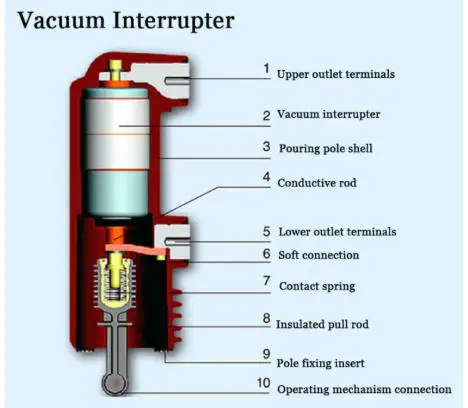
Working Principle of a Vacuum Circuit Breaker
The operating mechanism of a VCB follows a precise sequence:
- Normal Operation
The breaker contacts remain closed, allowing current to flow through the circuit. - Fault Detection
Protective relays detect abnormal conditions such as short circuits or overloads. - Contact Separation
The operating mechanism opens the contacts inside the sealed vacuum interrupter. - Arc Formation
A temporary arc forms due to metal vapor released from the contact surfaces. - Arc Extinction
Because of the vacuum environment, the arc rapidly extinguishes at the current zero point of the AC waveform. - Dielectric Recovery
The vacuum regains its insulation strength almost instantly, preventing arc re-ignition.
This fast interruption process allows VCBs to protect equipment effectively while minimizing damage to electrical systems.
Why Vacuum Circuit Breakers Are Preferred in Medium-Voltage Systems
1. Superior Arc-Quenching Performance
Vacuum is one of the most effective arc-extinguishing environments. Unlike air or oil, vacuum contains very few gas molecules, making it difficult for an arc plasma to sustain itself.
This results in:
- Faster arc extinction
- Reduced energy dissipation
- Lower contact erosion
These characteristics significantly improve system reliability and switching performance.
2. High Dielectric Strength
Vacuum offers extremely high insulation strength. After the arc is extinguished, the vacuum gap between contacts quickly recovers its dielectric properties.
This allows VCBs to handle high transient recovery voltages, which are common in medium-voltage distribution networks.
3. Long Mechanical and Electrical Life
A typical vacuum circuit breaker can achieve:
- 20,000–30,000 mechanical operations
- 10,000 or more electrical operations
Because the interrupter chamber is sealed and contact wear is minimal, VCBs often operate reliably for 20 years or more with minimal servicing.
4. Low Maintenance Requirements
Compared with oil circuit breakers or air blast breakers, VCBs require very little maintenance.
They do not require:
- Oil replacement
- Gas refilling
- Arc chamber cleaning
This reduces both operational costs and downtime in industrial facilities.
5. Compact and Space-Saving Design
Vacuum interrupters are relatively small, allowing manufacturers to design compact switchgear panels.
This is particularly beneficial in:
- Industrial plants
- Urban substations
- Commercial buildings
- Data centers
Compact designs also simplify installation and switchgear integration.
Typical Applications of Vacuum Circuit Breakers
Vacuum circuit breakers are widely used in medium-voltage power distribution systems, typically ranging from 3.3 kV to 36 kV.
1. Industrial Power Distribution
Manufacturing plants use VCBs to protect:
- Large motors
- Industrial transformers
- Capacitor banks
- Production equipment
2. Utility Distribution Networks
Electric utilities install VCBs in medium-voltage substations to protect feeders and distribution transformers.
3. Renewable Energy Power Plants
Wind and solar installations require reliable switching devices to connect power generation equipment to the grid.
VCBs help protect:
- Inverter systems
- Step-up transformers
- Distribution feeders
4. Railway Electrification Systems
Railway traction substations rely on fast and reliable switching equipment, making VCBs ideal for rail power distribution networks.
5. Commercial Infrastructure
Large facilities such as hospitals, airports, and data centers depend on high-reliability electrical protection systems where vacuum circuit breakers are commonly used.
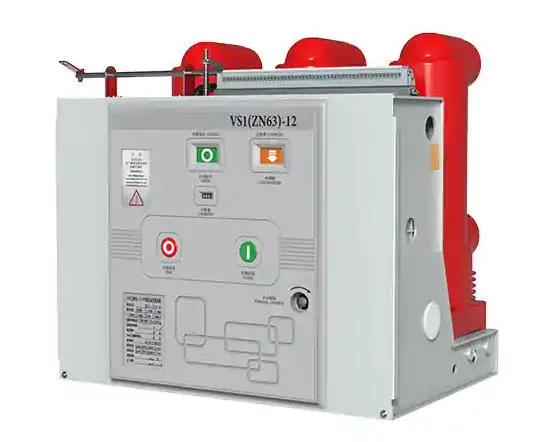
Vacuum Circuit Breaker vs ACB vs SF₆ Breaker
Different types of circuit breakers are designed for different voltage levels and applications.
| Feature | Vacuum Circuit Breaker | Air Circuit Breaker | SF₆ Circuit Breaker |
|---|---|---|---|
| Arc Medium | Vacuum | Air | SF₆ Gas |
| Typical Voltage | 3.3 kV – 36 kV | < 1 kV | 72.5 kV – 800 kV |
| Maintenance | Very Low | Medium | Medium |
| Fire Risk | None | None | Very Low |
| Environmental Impact | Low | Low | SF₆ greenhouse gas |
| Common Application | Medium-voltage switchgear | Low-voltage distribution | High-voltage transmission |
Organizations such as ABB, Schneider Electric, and Siemens Energy widely deploy vacuum technology in modern medium-voltage switchgear systems.
Typical Technical Specifications of a VCB
The specifications of vacuum circuit breakers vary depending on the manufacturer and application. However, typical ratings include:
- Rated voltage: 12 kV / 24 kV / 36 kV
- Rated current: 630 A – 3150 A
- Short-circuit breaking current: 20 kA – 40 kA
- Mechanical life: 20,000 operations
- Operating mechanism: spring-charged or motorized
These parameters ensure that VCBs can handle demanding industrial and utility applications.
How to Choose the Right Vacuum Circuit Breaker
Selecting the appropriate VCB requires careful evaluation of several factors.
1. Rated Voltage
The breaker voltage rating must match the system voltage level.
2. Short-Circuit Breaking Capacity
The breaker must safely interrupt the maximum fault current expected in the system.
3. Rated Current
Choose a breaker with sufficient current capacity for the connected load or feeder.
4. Installation Type
VCBs are available in different configurations:
- Fixed type
- Withdrawable type
- Indoor switchgear installation
- Outdoor substation installation
5. Operating Mechanism
Common operating mechanisms include:
- Spring-operated mechanism
- Magnetic actuator
- Motor-charged systems
Proper selection ensures reliable long-term system performance.
Industry Trends and Market Development
The global demand for vacuum circuit breakers continues to grow due to:
- Expansion of medium-voltage distribution networks
- Rapid development of renewable energy infrastructure
- Replacement of aging oil circuit breakers
- Increased emphasis on environmentally friendly switchgear
According to industry analyses and reports from electrical organizations such as IEEMA (Indian Electrical & Electronics Manufacturers’ Association), vacuum interrupter technology is becoming the dominant solution for medium-voltage power protection.
Furthermore, stricter environmental regulations are encouraging utilities to reduce reliance on SF₆ gas, accelerating the transition toward vacuum-based switching solutions.
FAQ
Vacuum circuit breakers are primarily used in medium-voltage systems between 3.3 kV and 36 kV, such as industrial distribution networks and utility substations.
Vacuum has very high dielectric strength and extremely low ionization, allowing arcs to extinguish rapidly at current zero and preventing re-ignition.
Most vacuum circuit breakers have a service life of 20 years or more, with mechanical operation ratings exceeding 20,000 cycles.
Conclusion
Vacuum circuit breakers play a crucial role in modern power distribution systems. Their fast arc-quenching capability, high reliability, compact design, and low maintenance requirements make them the preferred protection device for medium-voltage networks.
As industries expand and electrical infrastructure becomes more complex, VCB technology will continue to support safe, efficient, and environmentally responsible power system operation.
 FA
FA  EN
EN  FR
FR  ES
ES  PT
PT  IT
IT  RU
RU  AR
AR