




Single Phase IGBT Pure Sine Wave Inverter Voltage Regulator Stabilizer
20KVA Single-Phase Full Automatic AC Voltage Stabilizer AVR For Refrigerator
30KVA Automatic Voltage Regulator for Home & Office Use
Customized Single Phase Wall Mounted 0.5kVA-10kVA Automatic Voltage Stabilizer
The Customized Single Phase Wall Mounted Automatic Voltage Stabilizer is designed to provide reliable voltage regulation and protection for household and commercial electrical appliances. With a power range from 3.5kVA to 10kVA, this wall-mounted stabilizer ensures steady, safe, and efficient power delivery, even in areas with unstable or fluctuating mains voltage.
Built with advanced relay or servo motor control technology, it maintains a constant 220V output by automatically correcting under-voltage or over-voltage conditions. Compact, quiet, and efficient, it’s ideal for homes, offices, and small businesses seeking dependable voltage protection in a sleek wall-mounted design.
Air conditioners are no longer a luxury—they’re essential. But in many regions, unstable power supply raises a critical question:
Do you really need a voltage stabilizer for your AC?
The answer isn’t a simple yes or no. It depends on your local voltage conditions, the type of air conditioner you use, and how much risk you’re willing to take with expensive equipment like compressors.
This guide breaks it down in a practical, no-nonsense way.
Quick Answer
In areas with stable electricity, a stabilizer may not be strictly necessary.
But if your voltage fluctuates—even occasionally—installing an AC voltage stabilizer is one of the simplest ways to prevent costly damage and extend your AC’s lifespan.
What Is a Voltage Stabilizer?
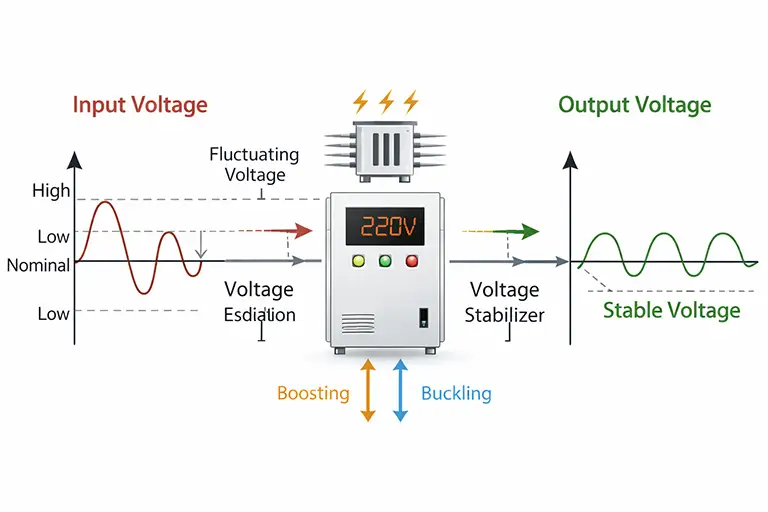
A voltage stabilizer is a device that keeps your power supply within a safe range, even when incoming voltage rises or drops.
Instead of passing unstable power directly to your air conditioner, the stabilizer adjusts it in real time—ensuring consistent, safe operation.
How It Works (Simple Explanation)
When voltage fluctuates:
- The stabilizer detects the change instantly
- It corrects the voltage using internal components (transformers, relays, or servo motors)
- Your AC continues running smoothly without stress
👉 Think of it as a “power buffer” between your AC and an unreliable grid.
Why Voltage Stability Matters for Air Conditioners
Air conditioners are actually more sensitive to voltage fluctuations than most home appliances.
That’s because:
- They use compressors with high starting current
- They run for long hours continuously
- Internal electronics (PCBs) are vulnerable to spikes
What Can Go Wrong Without a Stabilizer?
- Compressor damage from low voltage
- Overheating of wiring and components
- Frequent auto cut-offs or tripping
- Reduced cooling performance
- Shorter equipment lifespan
👉 In real-world terms: a small voltage issue today can turn into a compressor replacement tomorrow.
Do You Need a Stabilizer for Your AC?
✔ You SHOULD Install One If:
- Your area has frequent voltage fluctuations
- Voltage often falls outside 230V ±10% (207V–253V)
- Lights dim when heavy appliances start
- You’re using a non-inverter (fixed speed) AC
- Your building has older electrical wiring
⚠️ What About Inverter ACs?
Many people assume inverter ACs don’t need stabilizers. That’s only partly true.
Most modern inverter ACs have:
✔ Wide voltage operating range (e.g., 160V–260V)
❌ But NOT a true stabilizer
👉 That means:
- They can tolerate fluctuations
- But they don’t fully regulate or clean the voltage
Bottom line:
Even inverter ACs benefit from a stabilizer in areas with unstable or extreme voltage conditions.
Real-World Scenario: When a Stabilizer Becomes Necessary
If you notice any of these:
- Lights flicker when AC starts
- AC shuts down randomly
- Cooling feels inconsistent
- Other appliances behave abnormally
👉 Your power supply is already unstable.
In this case, a stabilizer isn’t optional—it’s preventive protection.
Types of Voltage Stabilizers for AC
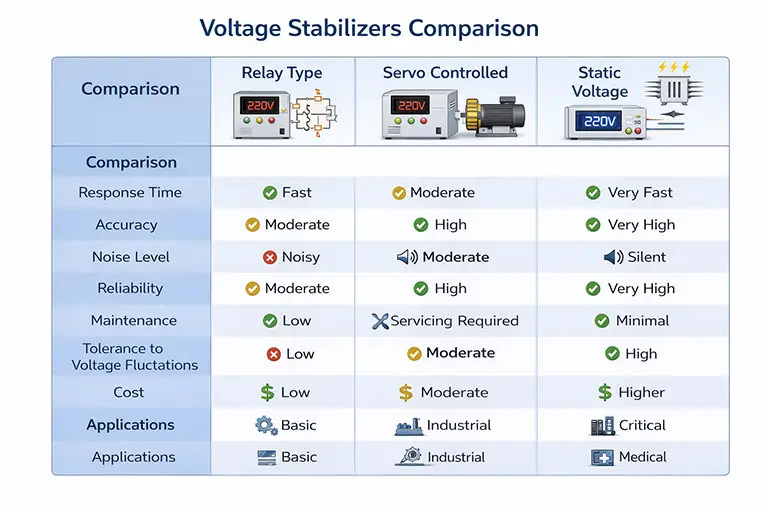
Choosing the right type makes a big difference in performance and cost.
1. Relay-Type Stabilizer (Budget Option)
- Uses relay switching
- Suitable for small fluctuations
- Affordable and widely used
2. Servo-Controlled Stabilizer (Best for Performance)
- Uses a servo motor for precise correction
- Accuracy up to ±3%
- Ideal for homes, commercial ACs, and HVAC systems
3. Static Stabilizer (High-End Solution)
- No moving parts
- Ultra-fast response
- Best for sensitive or critical systems
How to Choose the Right Stabilizer for Your AC
Here’s a quick practical guide:
✔ Match Capacity Correctly
- 1 Ton AC → ~4 kVA
- 1.5 Ton AC → ~5 kVA
- 2 Ton AC → ~6–8 kVA
👉 Always size slightly higher to handle startup load.
✔ Check Input Voltage Range
If your area has large fluctuations, choose a stabilizer with a wider working range.
✔ Look for Essential Protection Features
- Overload protection
- Short circuit protection
- Thermal protection
- Delay start (important for compressors)
✔ Don’t Ignore Build Quality
A cheap stabilizer can fail when you need it most.
Choose a manufacturer with real engineering capability—not just a trader.
External Stabilizer vs Built-in Protection
| Feature | Built-in AC Protection | External Stabilizer |
|---|---|---|
| Voltage Range | Limited | Wide |
| Accuracy | Moderate | High |
| Protection Level | Basic | Advanced |
| Equipment Lifespan | Moderate | Significantly improved |
👉 If your power supply isn’t perfect, external stabilization is the safer choice.
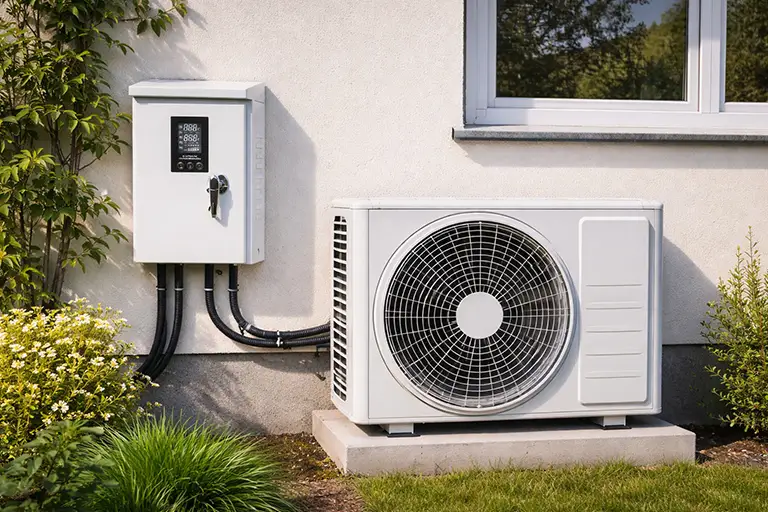
Where AC Voltage Stabilizers Are Commonly Used
- Residential homes and apartments
- Commercial buildings and offices
- Retail stores and restaurants
- Industrial cooling systems
- Server rooms and data centers
FAQ
Yes—but only if voltage is consistently stable. Otherwise, long-term damage risk increases.
They can handle wider voltage ranges, but they don’t fully stabilize power. External stabilizers still provide better protection.
Low voltage can:
Damage the compressor
Cause overheating
Reduce cooling efficiency
Typically 5 kVA stabilizer , but it’s safer to choose based on actual voltage conditions and startup current.
Final Recommendation
If your power supply is even slightly unstable, installing a voltage stabilizer is a smart, low-cost way to avoid expensive AC repairs.
At ZHENGXI, we provide custom-engineered voltage stabilizers for air conditioners, from residential units to large commercial HVAC systems. Whether you need a cost-effective relay stabilizer or a high-precision servo solution, our team can match the right model to your exact voltage conditions.
👉 Not sure what stabilizer you need?
Send us your AC specs or local voltage range—we’ll recommend the right solution quickly and accurately.