




In industrial environments, unstable voltage is not just an inconvenience — it directly impacts equipment lifespan, production efficiency, and operational cost. CNC machines, medical imaging systems, data centers, compressors, and HVAC systems all require stable input voltage to operate within design tolerance.
For project engineers and procurement managers, understanding voltage stabilizer price factors is essential to avoid:
- Under-specification that leads to system failure
- Overspending on unnecessary features
- Long-term maintenance and downtime costs
This guide explains what truly determines industrial voltage stabilizer price, how price per kVA is calculated, and how to choose the right manufacturer.
What Is a Voltage Stabilizer?
A voltage stabilizer — also known as an Automatic Voltage Regulator (AVR) — is a device that maintains constant output voltage despite input fluctuations.
According to power quality practices outlined in IEEE standards such as IEEE 11591, voltage sags and fluctuations are among the leading causes of industrial equipment malfunction.
Industrial stabilizers typically use one of three regulation methods:
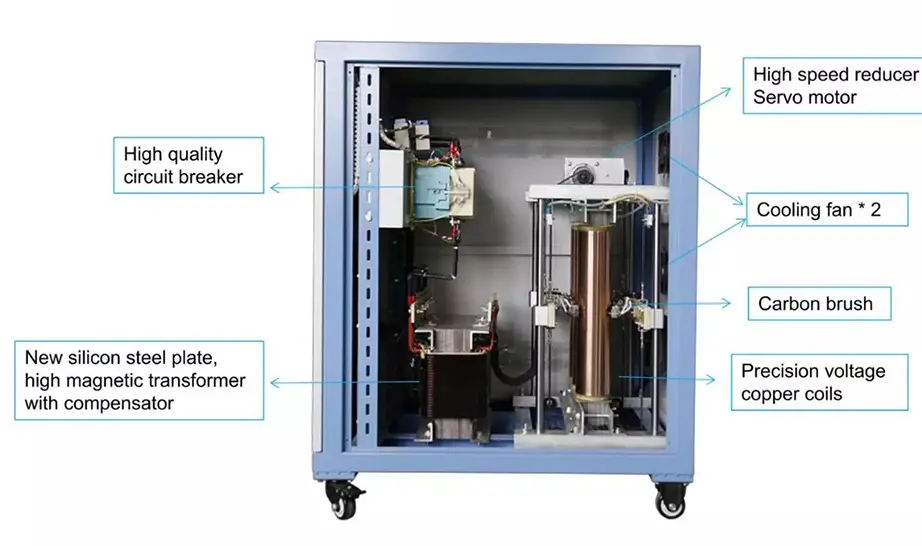
- Servo motor–driven transformer regulation
- Static electronic regulation (IGBT/SCR based)
- Relay step switching
Each technology has different performance characteristics and cost structures.
Core Factors That Determine Voltage Stabilizer Price
Voltage stabilizer pricing is not fixed. It varies significantly depending on engineering requirements, materials, and application environment.
1. Capacity (kVA Rating) — The Primary Cost Driver
Capacity is the single most important pricing factor.
Typical industrial ranges:
- 10–50 kVA (small commercial)
- 50–200 kVA (factory machinery)
- 200–3000+ kVA (heavy industrial plants)
Higher kVA means:
- More copper winding
- Larger CRGO silicon steel core
- Stronger mechanical frame
- Enhanced cooling system
Voltage Stabilizer Price Per kVA
Industrial servo stabilizers are often priced on a per kVA basis.
However, price per kVA decreases slightly at higher capacities due to scaling efficiency, while material costs (especially copper) heavily influence final pricing.
When searching:
- 100 kVA voltage stabilizer price
- 200 kVA three phase stabilizer cost
- 500 kVA industrial stabilizer quotation
You are essentially comparing copper content, transformer design, and regulation technology.
2. Single Phase vs Three Phase
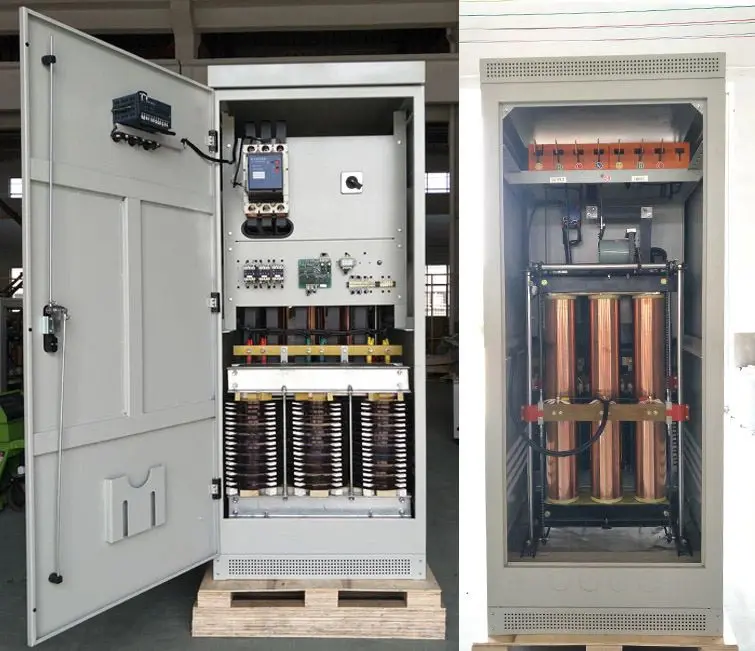
Three-phase voltage stabilizers cost significantly more than single-phase units due to:
- Three independent regulation assemblies
- Phase balancing systems
- Industrial protection circuitry
For factories and data centers, three-phase stabilizers are standard.
3. Technology Type
Technology dramatically affects both performance and price.
Relay Type (Entry Level)
- Step regulation
- ±5–10% accuracy
- Suitable for residential use
Lowest price, not recommended for industrial precision loads.
Servo Voltage Stabilizer (Industrial Standard)
- Continuous voltage correction
- ±1% accuracy available
- High durability
- Cost-effective for manufacturing
Most widely used in factories.
Static Voltage Stabilizer (Premium Solution)
- No moving parts
- Ultra-fast response (<20ms)
- High efficiency (≥98%)
- Ideal for data centers & medical systems
Higher upfront cost but minimal mechanical wear.
4. Input Voltage Range
Wider input range increases price.
Examples (three-phase):
- Standard: 320–450V
- Wide range: 240–480V
- Ultra-wide: 160–500V
Wide range design requires:
- Extended transformer tapping
- Larger servo movement span
- Advanced sensing system
This adds material and control complexity.
5. Accuracy Requirement
Precision directly impacts controller design.
| Accuracy | Typical Use | Price Level |
|---|---|---|
| ±5% | General loads | Low |
| ±2% | Commercial systems | Medium |
| ±1% | CNC, labs, medical | High |
Higher precision requires digital microcontroller boards and advanced voltage sampling.
6. Cooling Method
Cooling affects reliability and price.
- Air-cooled (AN) – Most common
- Oil-cooled (ONAN) – Used for high kVA
- Forced cooling (AF/OF) – Heavy-duty systems
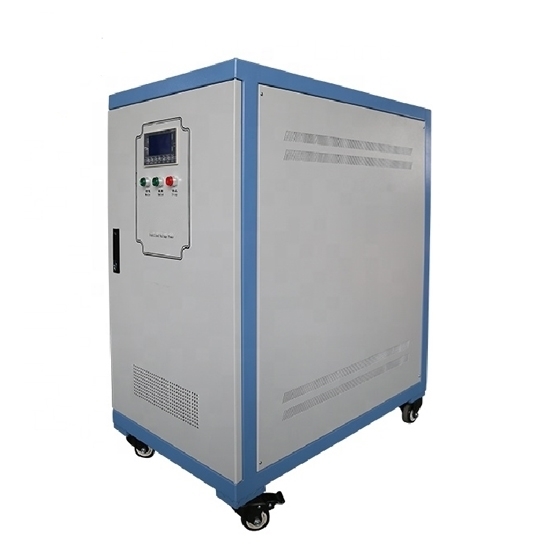
Oil-cooled designs are common in large servo stabilizers where thermal stability directly impacts regulation accuracy.
7. Protection & Certification
Industrial stabilizers typically include:
- Over/under voltage protection
- Overload protection
- Short circuit protection
- Phase failure detection
- Surge protection
Compliance with International Electrotechnical Commission standards and CE certification increases manufacturing and testing cost but ensures export reliability.
8. Enclosure & Environmental Rating
IP54/IP65 outdoor cabinets cost more than indoor cabinets.
Special industries may require:
- Stainless steel enclosure
- Explosion-proof design
- Anti-corrosion coating
These significantly influence price.
Typical Industrial Voltage Stabilizer Price Reference
While exact pricing varies by region and material cost, industrial pricing generally follows this structure:
| Type | 100 kVA Range | Application |
|---|---|---|
| Relay | Lowest | Light loads |
| Servo | Mid-range | Manufacturing |
| Static | Premium | Data centers |
Actual quotation depends on:
- Copper market price
- Input voltage range
- Accuracy requirement
- Cooling type
- Certification needs
For accurate budgeting, technical evaluation is essential.
Why Voltage Stabilizer Prices Differ Between Manufacturers
Not all suppliers are true manufacturers.
Price differences often reflect:
- Whether transformer winding is produced in-house
- Use of 100% copper vs aluminum winding
- Full-load testing before shipment
- Engineering customization capability
- Export-standard packaging and compliance
Industrial buyers should evaluate lifecycle reliability, not just purchase price.
Lower-cost assembly suppliers may reduce copper content or protection features, leading to higher maintenance cost later.
How to Choose the Right Stabilizer Without Overspending
Step 1: Calculate Real Load
Include:
- Total kW
- Power factor
- Motor starting current
Step 2: Measure Actual Grid Fluctuation
Record voltage variation over time before selecting input range.
Step 3: Define Required Accuracy
Precision loads require ±1% regulation.
Step 4: Allow 15–20% Capacity Margin
Prevents overload and future expansion issues.
Step 5: Select an Experienced Industrial Manufacturer
Look for:
- ISO-certified production
- In-house transformer workshop
- Copper quality verification
- International project references
FAQ
kVA capacity, technology type, input voltage range, and protection level.
Industrial servo stabilizers fall in the mid-range pricing category, while static stabilizers command premium pricing due to electronic regulation architecture.
For mission-critical systems where downtime is unacceptable, yes. Static stabilizers provide fast correction and zero mechanical wear
Conclusion
Voltage stabilizer pricing depends on:
- Capacity
- Regulation technology
- Voltage range
- Accuracy
- Cooling system
- Protection level
- Manufacturer capability
For industrial buyers, selecting the lowest price is rarely the lowest total cost.
A properly engineered stabilizer ensures:
- Equipment protection
- Reduced downtime
- Longer system lifespan
- Lower maintenance cost
Request a Technical Quotation
If you are sourcing an industrial voltage stabilizer (10 kVA–3000 kVA) for manufacturing, data centers, medical facilities, or infrastructure projects, working directly with an experienced manufacturer ensures accurate design and reliable performance.
Provide the following information for evaluation:
- Input voltage range
- Total load (kW or kVA)
- Phase type
- Required accuracy
- Installation environment
Our engineering team can recommend the most cost-effective configuration based on your real site conditions.
Source cited
- https://ieeexplore.ieee.org/document/475495 ↩︎
 EN
EN  FR
FR  ES
ES  PT
PT  IT
IT  RU
RU  AR
AR