




Introduction: Transformer vs Switchgear in Electrical Power Systems
Transformers and switchgear are core components in modern electrical power systems, but they perform fundamentally different functions.
For engineers, EPC contractors, and industrial buyers, understanding the difference between transformers and switchgear is essential for designing safe, efficient, and compliant power infrastructure.
A transformer is a static electrical device used to step up or step down voltage levels through electromagnetic induction, enabling efficient power transmission and distribution.
Switchgear, by contrast, is a combination of electrical control and protection devices—such as circuit breakers, disconnect switches, fuses, and relays—designed to control, protect, and isolate electrical circuits.
👉 In short:
- Transformers manage voltage and power transfer
- Switchgear manages safety, protection, and fault isolation
This article provides a technical comparison of transformers vs switchgear, covering working principles, design concepts, applications, advantages, and international standards.
Transformer Working Principle and Design
How a Transformer Works
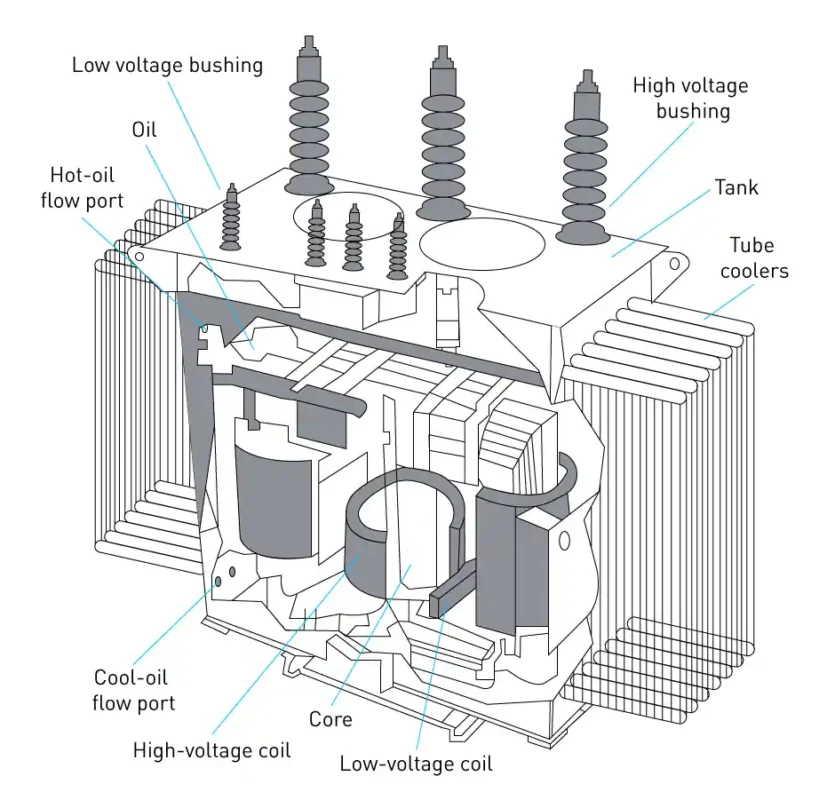
Transformers operate based on Faraday’s Law of Electromagnetic Induction. A standard transformer consists of:
- Primary winding and secondary winding (copper or aluminum)
- Magnetic core (laminated silicon steel or amorphous alloy)
- Insulation and cooling system (oil-immersed, dry-type resin, or air-cooled)
When alternating current (AC) flows through the primary winding, it generates a magnetic flux in the core, which induces a voltage in the secondary winding.
The voltage relationship is determined by the turns ratio:
Where:
- : Primary and secondary voltages
- : Number of turns
Common Types of Transformers
- Power Transformers – Used in transmission networks at high voltage levels
- Distribution Transformers – Reduce voltage for commercial and residential use
- Instrument Transformers – Provide accurate signals for metering and protection systems
Switchgear Working Principle and Design
What Is Switchgear and How Does It Work?
Switchgear is responsible for controlling, protecting, and isolating electrical equipment under both normal and fault conditions.
Key switchgear components include:
- Circuit breakers (vacuum, SF₆, air-insulated)
- Disconnect switches for safe isolation
- Protective relays for fault detection
- Busbars for power distribution
Switchgear operates by:
- Continuously monitoring current and voltage
- Detecting faults such as overloads or short circuits
- Interrupting fault currents and isolating affected sections
Types of Switchgear by Insulation Medium
- Air-Insulated Switchgear (AIS)
Cost-effective, easy to maintain, but requires more installation space - Gas-Insulated Switchgear (GIS)
Compact design using SF₆ gas insulation, ideal for urban substations and space-limited environments
Transformer vs Switchgear: Key Advantages Compared
Advantages of Transformers
- Voltage Regulation – Enables efficient long-distance transmission and safe utilization
- High Energy Efficiency – Typically 95–99% under rated load
- Long Service Life – 25–30 years or more due to minimal moving parts
- Scalable Design – Suitable for small distribution networks to large substations
Advantages of Switchgear
- Fast Fault Isolation – Prevents cascading failures
- Enhanced Personnel Safety – Arc-resistant enclosures and grounding systems
- System Flexibility – Supports radial, ring, and mesh network configurations
- Remote Monitoring – SCADA and smart grid compatibility
Application Scenarios: Transformer and Switchgear in Practice
Typical Transformer Applications
- High-voltage transmission substations
- Distribution networks for residential and commercial users
- Industrial plants with sensitive equipment
- Renewable energy systems (solar PV, wind power integration)
Typical Switchgear Applications
- Substations for feeder and transformer protection
- Data centers requiring uninterrupted power
- Industrial motor control and automation systems
- Grid-connected renewable energy installations
Transformer and Switchgear Standards Comparison
Transformer Standards
- IEC 60076 – International power transformer standards
- IEEE C57 Series – Design, testing, and efficiency requirements
- NEMA ST-20 – Distribution transformer guidelines (North America)
Switchgear Standards
- IEC 61439 – Low-voltage switchgear and controlgear assemblies
- IEEE C37 Series – AC circuit breaker ratings and testing
- ANSI / IEEE 242 – Protection and coordination guidelines
Compliance ensures safety, interoperability, and global acceptance.
FAQs: Transformer vs Switchgear
1. Can transformers and switchgear replace each other?
No. Transformers and switchgear serve different purposes. Transformers change voltage levels, while switchgear protects and controls circuits. They are used together, not interchangeably.
2. How do engineers choose switchgear for high-voltage systems?
Key factors include:
- Short-circuit withstand rating
- Insulation type (GIS vs AIS)
- Environmental conditions such as dust, humidity, and temperature
3. Why are oil-immersed transformers still widely used?
Transformer oil offers excellent insulation and cooling performance. While dry-type and eco-friendly fluids are increasing in popularity, oil-filled transformers remain cost-effective and reliable for high-power applications.
Conclusion
Transformers and switchgear play complementary but distinct roles in electrical power systems.
- Transformers enable efficient voltage conversion and power transmission
- Switchgear ensures system protection, fault isolation, and operational safety
For reliable power system design, engineers and decision-makers must understand how transformers and switchgear work together to build safe, efficient, and standards-compliant electrical networks.
