




In modern power distribution systems, the importance of voltage regulation cannot be overstated, especially when it comes to the protection of sensitive equipment from voltage fluctuations that may affect the reliability of the system. Among the most effective and cost-saving solutions to address minor voltage fluctuations is the buck/boost transformer used in a voltage regulator system.
This article will discuss the basic concept of buck/boost transformers, the principle of their working, their applications, parameters, and their difference from other voltage regulation methods.
1. Core Concept: What Is a Buck/Boost Transformer?
A buck/boost transformer is a special type of transformer designed to slightly increase (“boost”) or decrease (“buck”) the supply voltage. Unlike isolation transformers, buck/boost transformers are typically connected as autotransformers, meaning the primary and secondary windings are electrically connected.
The principle is simple:
- Boost mode – Adds a small voltage (e.g., +10V, +20V) to compensate for undervoltage.
- Buck mode – Subtracts a small voltage (e.g., −10V, −20V) to correct overvoltage.
According to IEEE standards, voltage variation beyond ±5% of rated voltage may affect equipment performance. Buck/boost transformers provide a reliable way to correct these deviations without replacing the entire power system.
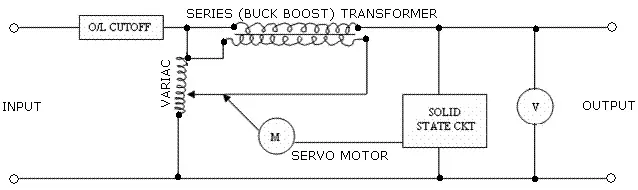
2. How a Buck/Boost Transformer Works in a Voltage Regulator
In a voltage regulator, the buck/boost transformer is connected in series with the supply line. Instead of handling the full load power, it only processes the voltage correction portion.
Working Mechanism:
- The main supply voltage enters the regulator.
- The buck/boost transformer adds or subtracts a small voltage.
- The corrected voltage is delivered to the load.
For example:
- Input voltage: 208V
- Required voltage: 220V
- Transformer boost: +12V
- Output voltage: 220V
This method is highly efficient because the transformer does not need to be rated for the full system kVA—only the correction voltage × load current.
3. Applications of Buck/Boost Transformers
Buck/boost transformers are widely used across industries where slight voltage mismatch occurs between supply and equipment rating.
Common Applications:
- Industrial machinery (CNC machines, motors)
- HVAC systems
- Data centers and server racks
- Medical equipment
- Renewable energy systems (solar inverters)
- Commercial buildings
Manufacturers such as ABB and Schneider Electric often incorporate voltage correction technologies in industrial power solutions, especially where grid instability is common.
4. Market Trends and Industry Background
Global power demand is increasing due to:
- Industrial automation
- EV charging infrastructure
- Renewable energy integration
- Data center expansion
According to industry reports referenced by IEEMA, transformer demand is steadily growing in emerging markets where grid voltage fluctuation is more common.
Meanwhile, grid modernization efforts documented by Wikipedia highlight that distributed energy systems introduce voltage variability. As a result, cost-effective voltage correction solutions like buck/boost transformers are gaining popularity.
Compared to fully electronic voltage stabilizers, buck/boost transformer-based regulators remain attractive due to:
- Simplicity
- High reliability
- Lower maintenance
- Long service life
5. Technical Parameters and Selection Guide
When selecting a buck/boost transformer for a voltage regulator, the following technical parameters must be considered:
Key Specifications:
- Input Voltage (e.g., 200V, 208V, 380V, 400V)
- Output Voltage Requirement
- Correction Voltage (±5%, ±10%, ±15%)
- Load Current (Amps)
- Phase Type (Single-phase or Three-phase)
- Frequency (50Hz / 60Hz)
- Insulation Class (Class F, Class H)
- Cooling Method (Air-cooled / Oil-cooled)
kVA Calculation Formula:
kVA=1000Voltage Correction×Load Current
Because the transformer only handles correction voltage, its kVA rating is much smaller than the total load kVA—making it economically efficient.
6. Difference Between Buck/Boost Transformers and Other Voltage Regulation Methods
| Feature | Buck/Boost Transformer | Servo Voltage Stabilizer | Static Voltage Regulator |
|---|---|---|---|
| Regulation Type | Fixed correction | Automatic mechanical adjustment | Electronic control |
| Response Speed | Instant (fixed) | Medium | Fast |
| Cost | Low | Medium | High |
| Maintenance | Very low | Requires periodic service | Low |
| Best For | Stable but offset voltage | Fluctuating voltage | Sensitive equipment |
If voltage fluctuation is minimal but consistently offset, buck/boost is ideal. For wide fluctuations (±20% or more), a servo or static regulator may be better.
【img】
alt=”Comparison chart of buck boost transformer vs servo stabilizer voltage regulation methods”
7. Advantages of Buck/Boost Transformers in Voltage Regulators
- High efficiency (typically >98%)
- Compact size
- Lower initial investment
- Long operational lifespan (15–25 years)
- Minimal moving parts
- High reliability in industrial environments
Because there are no carbon brushes or motorized components, the failure rate is extremely low compared to servo stabilizers.
8. Buying Considerations for Industrial Users
When purchasing a buck/boost transformer-based voltage regulator, consider:
- Accurate Voltage Measurement – Measure actual load voltage under full load.
- Future Expansion Margin – Add 10–20% capacity buffer.
- Environmental Conditions – Ambient temperature, humidity, altitude.
- Compliance Certifications – CE, UL, ISO standards.
- Copper vs. Aluminum Windings – Copper offers better conductivity and durability.
For OEM or export projects, custom voltage combinations (e.g., 380V to 400V, 208V to 230V) are often required.
Working with an experienced manufacturer ensures proper winding design, insulation coordination, and thermal management.
9. FAQ
No. Buck/boost transformers are designed for small, fixed voltage corrections (typically ±5–20%). For large fluctuations, an automatic voltage stabilizer is recommended.
Generally, no. Most buck/boost transformers operate as autotransformers and do not provide galvanic isolation. If isolation is required, a separate isolation transformer must be used.
Multiply the voltage correction value by the load current, then divide by 1000 to get kVA. Always add a safety margin for continuous operation.
Conclusion
A buck/boost transformer in a voltage regulator is a practical and efficient solution for correcting minor voltage mismatches in industrial and commercial applications. By adding or subtracting a small voltage in series with the supply line, it ensures equipment receives stable and correct voltage without requiring large, expensive stabilization systems.
As power grids evolve and voltage stability challenges continue, this simple yet highly reliable technology remains an essential component in modern electrical infrastructure.
For manufacturers, system integrators, and industrial users, understanding the proper selection and application of buck/boost transformers ensures optimized performance, reduced downtime, and long-term cost savings.
 EN
EN  FR
FR  ES
ES  PT
PT  IT
IT  RU
RU  AR
AR