




Modern computers are undeniably more advanced than their predecessors. With high-efficiency power supplies, wide input voltage tolerance, and built-in protection circuits, many users assume that an AVR (Automatic Voltage Regulator) is no longer necessary.
But is that really true?
The short answer: it depends on your power environment.
In regions with stable grid infrastructure, a modern PC may operate safely without an external voltage stabilizer. However, in areas where voltage fluctuation, brownouts, or long-term instability are common, using an AVR for computer systems remains a practical and professional choice.
From a power equipment manufacturer’s standpoint, most computer failures related to power are not caused by dramatic surges—but by persistent undervoltage and repeated voltage instability that never triggers obvious protection alarms.
This guide explains:
- How modern computer power supplies actually handle voltage
- When a voltage stabilizer for computer use is still necessary
- How to choose the best AVR for computer protection based on real-world conditions
What Is an AVR and What Does It Do?
An Automatic Voltage Regulator (AVR) is designed to maintain a stable output voltage even when the incoming utility voltage fluctuates.
Key Functions of an AVR for Computer Applications
- Corrects long-duration undervoltage (brownouts)
- Limits sustained overvoltage conditions
- Reduces thermal and electrical stress on PC components
- Helps prevent unexpected shutdowns and long-term hardware degradation
Voltage regulation is especially important in regions where grid voltage regularly deviates beyond ±10% of nominal values.
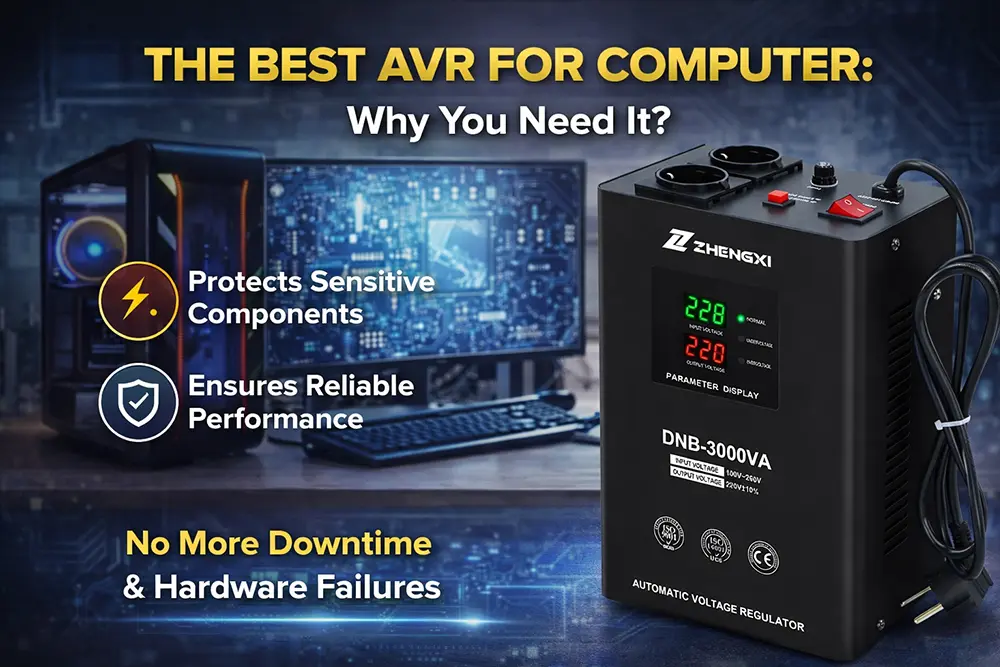
Common AVR Technologies Used for PCs
An automatic voltage regulator for computer systems typically uses one of the following methods:
- Servo motor regulation – smooth correction, slower response
- Relay-based step regulation – economical, stepped adjustment
- Solid-state electronic regulation – fast response, higher precision
Each design differs in response speed, accuracy, noise level, and cost.
How Modern Computer Power Supplies Handle Voltage
Most modern computers use switch-mode power supplies (SMPS), which already offer some voltage tolerance.
Typical SMPS Input Characteristics
- Input range: 100V–240V AC, 50/60 Hz
- Built-in protections:
- Over-voltage protection (OVP)
- Under-voltage protection (UVP)
- Basic surge suppression
However, this wide input range reflects short-term tolerance under ideal conditions, not guaranteed performance under prolonged instability.
Important Limitation of Built-In PSU Protection
Modern PSUs are designed to shut down during extreme events, not to continuously correct voltage.
In real-world office and factory environments, persistent low voltage often leads to:
- Reduced PSU efficiency
- Increased internal heat
- Premature capacitor aging
- Random reboots during CPU or GPU load spikes
This is where an external voltage stabilizer for PC systems becomes relevant—not as redundancy, but as protection.
When Is a Voltage Stabilizer for PC Still Necessary?
1. Regions with Unstable Power Grids
In many developing, rural, or industrial regions, voltage swings of ±15–25% are common.
An AVR for computer use is strongly recommended if you experience:
- Flickering lights
- Appliances resetting unexpectedly
- Measured voltage below 190V or above 250V (for 230V systems)
2. High-Performance PCs and Workstations
Gaming PCs, CAD workstations, and AI/ML systems draw highly dynamic loads.
Sudden GPU or CPU load spikes combined with unstable input voltage can overwhelm PSU regulation logic.
A properly sized voltage stabilizer for computer setups helps protect:
- Motherboards
- GPUs
- SSDs and HDDs
3. Offices, Studios, and Small Server Rooms
In environments where uptime matters—such as:
- Design studios
- Financial offices
- Small IT rooms
Stable voltage is essential. Power quality studies consistently show that voltage sags are the most frequent cause of electronic equipment disturbances worldwide.
Best AVR for Computer: What Actually Matters
When users search for the best AVR for computer systems, brand names alone are not the answer.
Key Technical Parameters to Evaluate
| Parameter | Recommended Value |
|---|---|
| Capacity (VA) | ≥ 1.5× total PC wattage |
| Input Voltage Range | Wide (e.g. 140–260V) |
| Regulation Accuracy | ±3% to ±10% |
| Response Time | < 20 ms preferred |
| Waveform | No waveform distortion |
| Protection | Overload, surge, short circuit |

Single PC Sizing Example
- Desktop PC + monitor: ~600W
- Recommended AVR capacity: 1000–1500VA
This margin ensures stable performance and avoids long-term overload stress.
AVR vs UPS vs Surge Protector: Key Differences
Voltage Stabilizer vs Surge Protector
- Surge protectors handle short spikes only
- AVRs correct continuous over- and undervoltage
AVR vs UPS
- UPS provides battery backup
- AVR provides real-time voltage correction
Many UPS units include built-in AVR, but not all.
In areas with both voltage fluctuation and outages, a UPS with integrated AVR is often the most complete solution.
Voltage Stabilizer for Computer Price: What to Expect
Typical Price Ranges (Indicative)
- Small PC AVR (1–2 kVA): USD 30–80
- High-precision electronic AVR: USD 80–150
- Industrial-grade stabilizers: higher, depending on design
The voltage stabilizer for computer price is usually lower than replacing:
- A power supply unit
- A motherboard
- A graphics card
From a cost-benefit perspective, an AVR is preventive protection, not an accessory.
How Modern AVRs Differ from Older Designs
Modern automatic voltage regulators for computer applications are:
- More compact
- Lower noise
- Faster response
- Higher efficiency
Compared with older transformer-heavy designs, today’s AVRs use improved control electronics and offer better waveform integrity and multi-layer protection.

Buying Advice: Choosing the Right AVR for Your PC
From a manufacturer’s perspective, the most common issue we see is undersized or low-quality AVRs selected purely by price.
Practical Selection Tips
- Measure your wall voltage at different times of day
- Check your PSU’s rated input range
- Avoid no-name or undersized stabilizers
- Look for CE / ISO / IEC compliance
If your voltage is consistently stable, a high-quality surge protector may be sufficient.
If not, a dedicated AVR for computer systems is the safer long-term choice.
FAQ: Common Questions About AVRs for Computers
1. Do modern computers really need an AVR?
Modern computers tolerate some voltage variation but do not correct voltage continuously. In unstable power environments, an AVR significantly improves long-term reliability.
2. Is a UPS better than a voltage stabilizer for PC use?
A UPS is ideal for backup power, while an AVR focuses on voltage stability. Many users choose a UPS with built-in AVR for complete protection.
3. Can an AVR damage my computer?
A properly sized, high-quality AVR will not damage your PC. Poor-quality or undersized units may introduce delays or noise.
4. How do I know if I actually need an AVR?
Measure your wall voltage over time. If it regularly deviates more than ±10% from nominal, an AVR is recommended.
Final Verdict: Do Modern Computers Need an AVR?
Modern computers are smarter—but power grids are not always reliable.
If you experience:
- Frequent voltage fluctuation
- Brownouts
- Industrial or rural power lines
Then yes—using a voltage stabilizer for computer protection remains a smart and professional choice.
For stable grids, it may be optional.
For unstable ones, it is essential insurance.
From an engineering and manufacturing perspective, AVRs continue to play a relevant role in modern PC power protection strategies.

Single Phase IGBT Pure Sine Wave Inverter Voltage Regulator Stabilizer
20KVA Single-Phase Full Automatic AC Voltage Stabilizer AVR For Refrigerator
30KVA Automatic Voltage Regulator for Home & Office Use
Customized Single Phase Wall Mounted 0.5kVA-10kVA Automatic Voltage Stabilizer
The Customized Single Phase Wall Mounted Automatic Voltage Stabilizer is designed to provide reliable voltage regulation and protection for household and commercial electrical appliances. With a power range from 3.5kVA to 10kVA, this wall-mounted stabilizer ensures steady, safe, and efficient power delivery, even in areas with unstable or fluctuating mains voltage.
Built with advanced relay or servo motor control technology, it maintains a constant 220V output by automatically correcting under-voltage or over-voltage conditions. Compact, quiet, and efficient, it’s ideal for homes, offices, and small businesses seeking dependable voltage protection in a sleek wall-mounted design.