



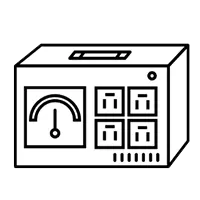

A UPS system acts as a backup power source in case the main power source fails or becomes unreliable. Its main function is to protect the equipment from malfunctioning, prevent unexpected shut downs, and keep critical electrical installations running smoothly.
PINE offers power protection services for industrial, commercial, or other projects that require reliable power backup solutions. A variety of UPS configurations are available depending on the capacity of the load, type of input/output required, battery life, and conditions of use.
Do you need an online UPS for critical equipment, a three phase UPS for an industrial plant, or a custom backup power system for a particular project? Choosing the right UPS configuration is important for reliable performance.
Being a manufacturer of power equipment, our company is concerned about practical applications’ needs such as load parameters, power quality, and time of backup, which can help our customers select the proper UPS solution.
Need a Proper UPS System? Contact Our Team for Further Consultation and Quote!

1000VA–3000VA Line Interactive Uninterruptible Power Supply for Home and Office Use
The online UPS adopts digital control technology, three-level technology, and high-frequency power conversion technology. It features a compact size, high performance, and high reliability, while delivering significant energy-saving benefits and greatly reducing operating costs. Integrating multiple functions, including AC voltage regulation, backup power supply, spike and surge absorption, it provides power protection in harsh grid environments, ensuring clean, safe, and stable power for connected loads.
Types of Uninterruptible Power Supply
UPS systems are generally classified into three main types according to their operating principles: Offline UPS, Line-Interactive UPS, and Online UPS.
1. Offline UPS (Standby UPS)
An offline UPS normally supplies power directly from the utility. When the input power fails or moves outside the acceptable operating range, it switches to battery power through its inverter.
Key features:
- Economical backup power solution
- Low energy consumption during normal operation
- Suitable for basic electronic equipment
- Has a short transfer time when switching to battery mode
Typical applications: Personal computers, office equipment, small networking devices, and point-of-sale systems.
2. Line-Interactive UPS
A line-interactive UPS includes an automatic voltage regulation (AVR) function to correct moderate input voltage fluctuations without frequently switching to battery power.
Compared with an offline UPS, it provides better voltage regulation and can reduce unnecessary battery usage.
Key features:
- Built-in voltage regulation
- Reduced battery switching
- Better protection against common voltage fluctuations
- Suitable for small and medium-sized applications
Typical applications: Small servers, network equipment, office systems, and retail equipment.
3. Online UPS (Double Conversion UPS)
An online UPS uses double-conversion technology. Incoming AC power is converted into DC and then converted back into regulated AC power through the inverter.
This design provides continuous power conditioning and protects connected equipment against many common input power disturbances. During normal double-conversion operation, there is no transfer interruption when switching to battery power.
Key features:
- Continuous double-conversion operation
- No transfer time when switching to battery power during normal operation
- Regulated output voltage and frequency
- Suitable for sensitive and critical loads
- Available in single-phase and three-phase configurations
Typical applications: Data centers, industrial automation, medical equipment, telecommunications, and critical infrastructure.
For equipment that cannot tolerate a power interruption, an online double-conversion UPS is generally the preferred option.
UPS Systems by Power Capacity and Configuration
Selecting a UPS involves more than choosing a rated capacity. The input and output phase, load characteristics, and required battery runtime must also match the installation.
Single-Phase UPS vs. Three-Phase UPS
| Comparison | Single-Phase UPS | Three-Phase UPS |
| Power supply | Single-phase AC | Three-phase AC |
| Typical loads | Small and medium loads | Medium and large loads |
| Installation | Offices and small equipment rooms | Industrial and commercial facilities |
| Applications | Computers, servers, network devices | Data centers, factories, critical infrastructure |
A single-phase UPS is generally suitable for smaller electrical loads, while a three-phase UPS is more appropriate for higher-capacity installations.
The actual choice should be based on the electrical design of the facility and the requirements of connected equipment.
UPS Capacity Selection
UPS capacity is commonly expressed in kVA, while the actual active power delivered to equipment is measured in kW.
When selecting a UPS, consider:
- Total connected load
- UPS output power factor
- Equipment starting current
- Short-term overload requirements
- Future load expansion
- Required battery backup time
For example, if the connected load is 10 kW and the UPS output power factor is 0.9, the minimum apparent power requirement is:
10 kW ÷ 0.9 = 11.11 kVA
This is only the initial calculation. Additional capacity may be required depending on load characteristics, transient demand, and future expansion.
How Does an Uninterruptible Power Supply Work?
A UPS monitors the incoming power supply and provides an alternative power source when the utility supply fails.
The operating process depends on the UPS topology.
In a typical online double-conversion UPS, the power flow works as follows:
- AC Input:Utility power enters the UPS.
- Rectification:The rectifier converts incoming AC power into DC power.
- Battery Charging:The DC system supplies the inverter and charges the battery.
- Inversion:The inverter converts DC power into regulated AC output.
- Power Failure:When utility power is interrupted, the battery supplies DC power to the inverter.
- Power Restoration:When utility power returns, the UPS resumes normal operation and recharges the battery.
Because the inverter continuously supplies the load during normal double-conversion operation, the transition to battery power does not interrupt the output.
A UPS may also include a static bypass circuit to provide an alternative power path under specified operating conditions.
Common Applications of UPS Systems
UPS systems are used in environments where unexpected power interruptions can cause equipment shutdowns, data loss, production delays, or operational risks.
Data Centers and IT Infrastructure
UPS systems protect servers, storage equipment, network devices, and other critical IT infrastructure. Reliable backup power helps prevent unexpected shutdowns and data processing interruptions.
Industrial Manufacturing
In manufacturing facilities, UPS systems support PLCs, industrial control panels, monitoring equipment, and automation systems. They help maintain control functions during power disturbances and provide time for safe shutdown procedures where required.
Healthcare Facilities
Hospitals and healthcare facilities use UPS systems for compatible medical equipment, monitoring systems, laboratory devices, and critical infrastructure.
For life-support and other essential medical applications, UPS selection must comply with applicable electrical safety standards and facility requirements.
Telecommunications
Telecommunication networks depend on continuous power availability. UPS systems provide backup power for network equipment, communication infrastructure, and related control systems.
Commercial Buildings
UPS systems can support security systems, access control, building management systems, emergency communication equipment, and other essential electrical loads.
How to Choose the Right UPS System?
Choosing the right UPS requires an understanding of both the electrical load and the operating environment. A system that is too small may fail to support the equipment, while an oversized system can increase initial investment and operating costs.
Here are the main factors to evaluate.
1. Calculate the Required UPS Capacity
Start by identifying the total load that needs backup power.
Check both:
- kW:Actual power consumed by the equipment.
- kVA:Apparent power required from the UPS.
The UPS must meet both its rated kW and kVA limits.
For motor-driven or inductive equipment, also evaluate starting current and transient load demand rather than relying only on the rated running power.
2. Select the Appropriate UPS Topology
Different applications require different levels of protection.
- Offline UPS: Basic backup for non-critical equipment.
- Line-Interactive UPS: Backup power with voltage regulation.
- Online UPS: Continuous power conditioning for sensitive and critical loads.
For industrial and critical applications, online UPS systems are often preferred when stable output and uninterrupted battery transfer are required.
3. Determine the Required Battery Backup Time
Battery runtime depends on several factors:
- Total connected load
- Battery voltage and capacity
- Battery chemistry
- Inverter efficiency
- Battery age and operating temperature
A UPS designed for 15 minutes of backup may require a different battery configuration from one designed for 30 or 60 minutes.
Battery sizing should be based on the required runtime and actual discharge characteristics, not simply the battery’s nominal capacity.
4. Confirm Input and Output Specifications
Before purchasing a UPS, confirm:
- Single-phase or three-phase input
- Single-phase or three-phase output
- Input voltage and frequency
- Output voltage and frequency
- Output power factor
- Required electrical protection
These specifications must match the facility’s electrical system and the equipment being protected.
5. Consider the Operating Environment
Temperature, ventilation, humidity, dust, installation space, and maintenance access can affect UPS performance and battery life.
For industrial installations, it is also important to consider harmonic characteristics, overload requirements, bypass arrangements, and maintenance conditions.
Engineering tip: Do not select a UPS based on kVA alone. Load behavior, backup time, and electrical compatibility are equally important when designing a reliable backup power system.
UPS vs. Voltage Stabilizer: What Is the Difference?
UPS systems and automatic voltage stabilizers (AVRs) both help protect electrical equipment, but their main functions are different.
| Comparison | UPS | Voltage Stabilizer |
| Main function | Backup power and power conditioning | Voltage regulation |
| Battery | Usually included | Not normally included |
| Power outage protection | Yes | No |
| Voltage regulation | Depends on UPS topology | Main function |
| Backup duration | Depends on battery capacity and load | No backup duration |
| Typical applications | Critical equipment | Equipment affected by unstable voltage |
A voltage stabilizer corrects input voltage fluctuations but cannot supply power during a complete outage unless paired with an independent backup source.
A UPS provides temporary power from its battery when the utility supply fails.
If your main concern is unstable grid voltage, a voltage stabilizer may be sufficient. If your equipment must continue operating during power outages, a UPS is generally the more appropriate solution.
In some installations, both systems may be used, provided their electrical compatibility and coordination are properly evaluated.
Why Choose PINE for UPS Solutions?
Choosing a UPS supplier involves more than comparing product prices. Product configuration, component quality, testing procedures, and technical support all affect long-term operating reliability.
PINE focuses on power equipment manufacturing and customized electrical solutions for industrial and commercial applications.
Our approach starts with understanding the customer’s electrical requirements and selecting a suitable configuration for the intended application.
Application-Based Product Selection
We consider connected load, input and output voltage, power factor, battery runtime, and operating conditions when evaluating UPS requirements.
Flexible Configurations
UPS configurations can be evaluated according to capacity, phase, voltage, battery arrangement, and application requirements, subject to available product models.
OEM and ODM Support
We support distributors, wholesalers, electrical contractors, and project buyers who require product customization and supply cooperation.
Quality Control
Product inspection, assembly procedures, and electrical testing are important parts of reliable power equipment manufacturing. Specific testing capabilities and certifications should be confirmed against the applicable UPS product range.
Technical Support
Our team can assist with specification review, product selection, and configuration discussions to help customers identify a suitable power protection solution.
Whether you are sourcing UPS products for distribution or planning a backup power system for an industrial project, the right technical configuration should always come before simply choosing a higher-rated model.
FAQ
1. What does UPS stand for?
UPS stands for Uninterruptible Power Supply. It is an electrical device that provides temporary backup power and protects connected equipment against power interruptions and certain electrical disturbances.
2. What are the three main types of UPS?
The three main types are Offline (Standby) UPS, Line-Interactive UPS, and Online (Double Conversion) UPS. They differ in voltage regulation, power conditioning, and transfer behavior.
3. What is the difference between a single-phase and three-phase UPS?
A single-phase UPS is generally used for smaller electrical loads, such as computers, servers, and office equipment. A three-phase UPS is designed for larger electrical systems, including industrial facilities, data centers, and commercial infrastructure.
4. How long can a UPS provide backup power?
Backup time depends on battery capacity, connected load, inverter efficiency, battery condition, and operating temperature. Small UPS units may provide several minutes, while larger systems with external battery cabinets can support longer backup periods.
5. What size UPS do I need for my equipment?
Calculate the total connected load in kW and kVA, then check the UPS output power factor and rated capacity. Also consider starting current, transient demand, required backup time, and future load expansion.
6. Is an online UPS suitable for industrial applications?
Yes. Online double-conversion UPS systems are commonly used for industrial control panels, PLCs, automation equipment, monitoring systems, and other critical electrical loads. The system must be selected according to the load characteristics and operating conditions.
7. Can a UPS stabilize voltage?
Some UPS systems provide voltage regulation and power conditioning. Online double-conversion UPS systems deliver regulated output through their inverter. Actual voltage regulation performance depends on the product design and specifications.
8. What is the difference between a UPS and an inverter?
A UPS is designed to provide backup power with automatic operation and additional power protection features. A standalone inverter mainly converts DC power into AC power and may require separate batteries and additional control equipment.
9. How often should UPS batteries be replaced?
Battery replacement depends on battery chemistry, operating temperature, charging conditions, usage, and maintenance. Regular battery inspection and capacity testing help identify deterioration before it affects backup performance.
10. Can UPS systems be customized?
Depending on the product model and project requirements, UPS configurations may support different input and output voltages, rated capacities, phase arrangements, battery configurations, and backup runtimes.
11. What information is needed to request a UPS quotation?
To evaluate a suitable UPS solution, provide the following information:
- Required UPS capacity (kVA or kW)
- Input voltage and phase
- Output voltage and phase
- Connected equipment and load characteristics
- Required battery backup time
- Installation environment
- Quantity and project application
Providing these details helps the supplier recommend a more suitable configuration and prepare an accurate quotation.
Get the Right Uninterruptible Power Supply for Your Application
A properly selected UPS helps protect critical equipment, reduce unexpected downtime, and maintain reliable operation when the main power supply is interrupted.
Whether you are a distributor looking for a dependable UPS supply partner or an engineering company sourcing backup power equipment for a specific project, PINE can assist with product selection and technical configuration discussions.
Tell us your required UPS capacity, input and output voltage, phase configuration, and backup time. Our team will help you evaluate a suitable solution for your application.
Contact PINE today for UPS product information, technical specifications, OEM/ODM inquiries, and project quotations.