




The current global electrical world is faced with issues of voltage compatibility, especially in the use of foreign equipment and construction of international industrial setups. The step-down transformer becomes very essential in the process of ensuring that electricity supplied at high voltages can be converted to low volts to avoid damage or wastage of energy.
Whether you are operating American machines with 220 volts power supply or industrial equipment, selection of the correct voltage step down transformer is imperative.
In this article, we discuss how step down transformers operate, applications of the devices, and the considerations to make during their selection.
What Is a Step Down Transformer?
A step down transformer is an electrical device that reduces high input voltage to a lower output voltage while keeping the frequency unchanged. It operates based on the principle of electromagnetic induction.
In simple terms:
👉 High voltage goes in → Lower voltage comes out
This makes it essential for applications where equipment must operate at a lower voltage than the available power supply.
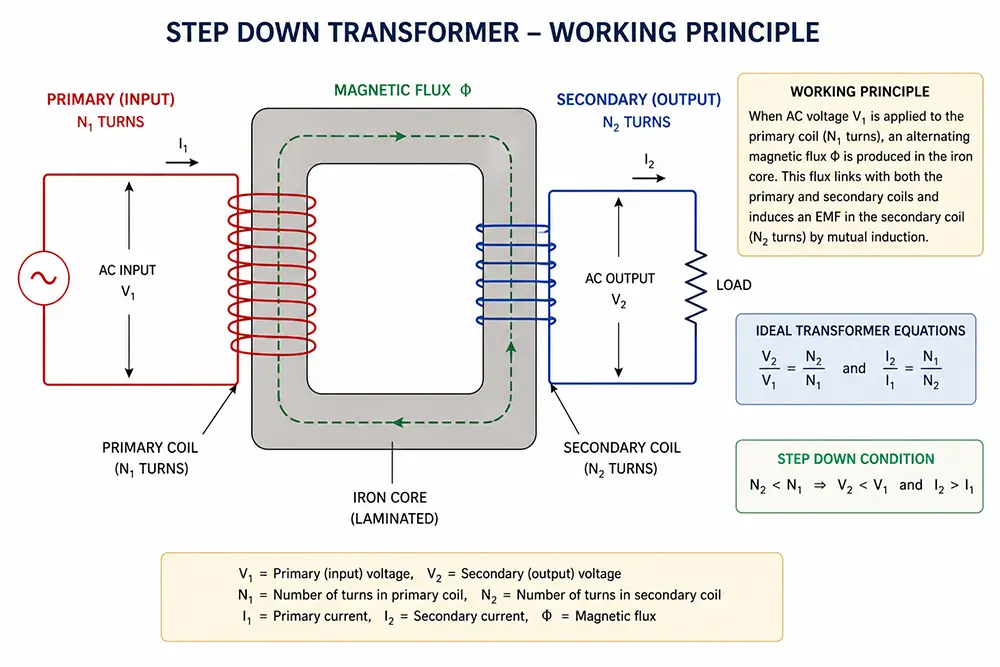
How Does a Step Down Transformer Work?
A transformer consists of two main coils:
- Primary winding (connected to input voltage)
- Secondary winding (connected to output load)
The voltage conversion depends on the number of turns in each coil:
V₁ / V₂ = N₁ / N₂
Where:
- V₁ = Primary voltage
- V₂ = Secondary voltage
- N₁ = Number of turns in primary coil
- N₂ = Number of turns in secondary coil
If the secondary coil has fewer turns than the primary coil, the output voltage is reduced.
👉 This simple but powerful principle allows transformers to deliver stable and efficient voltage conversion without changing frequency.
Common Voltage Conversion Scenarios
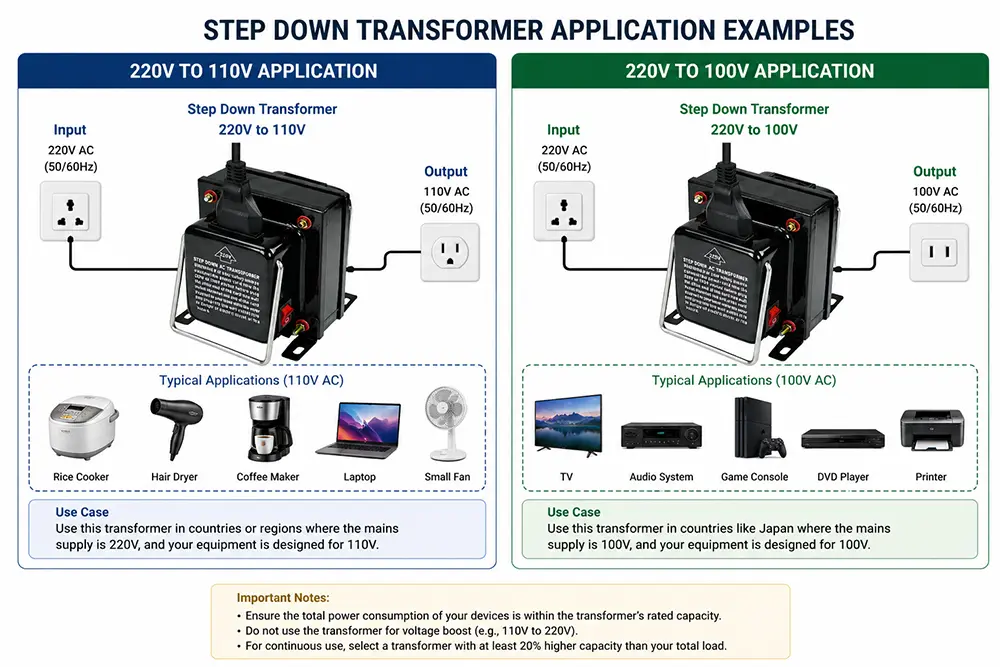
1. Step Down Transformer 220V to 110V
One of the most common real-world scenarios is using a 220V to 110V step down transformer to run North American devices in countries where the standard voltage is 220V–240V.
Typical use cases:
- Imported home appliances
- Office equipment
- Consumer electronics
2. Step Down Transformer 220V to 100V
Japanese electronics often operate at 100V. Using a 220V to 100V transformer ensures:
- Safe operation
- Stable performance
- Longer equipment lifespan
Applications of Step Down Transformers
Step down transformers are widely used across different industries:
Residential Use
- Running imported appliances safely
- Protecting sensitive electronics
Industrial Applications
- CNC machines
- Manufacturing equipment
- Control panels and automation systems
Commercial & IT Infrastructure
- Data centers
- Medical equipment
- Office systems
Renewable Energy Systems
- Solar power systems
- Grid integration and voltage regulation
👉 Leading electrical solution providers emphasize proper voltage management as a key factor in energy efficiency and equipment protection.
Technical Specifications You Should Know
Before choosing a transformer, it’s important to understand these key parameters:
- Input Voltage: e.g., 220V / 240V
- Output Voltage: e.g., 110V / 100V
- Power Rating (VA or kVA): Should exceed total load by 20–30%
- Frequency: 50Hz or 60Hz compatibility
- Efficiency: Typically 95%–98%
- Cooling Method: Air-cooled or oil-cooled
Step Down Transformer vs Voltage Converter
| Feature | Step Down Transformer | Voltage Converter |
|---|---|---|
| Efficiency | High | Moderate |
| Durability | Long lifespan | Short lifespan |
| Load Capacity | High | Limited |
| Output Stability | Very stable | May fluctuate |
| Application | Industrial & continuous use | Travel & light-duty |
👉 Conclusion: If you need reliable, long-term performance, a transformer is always the better choice.
Step Down vs Other Transformer Types
Step Down vs Step Up Transformer
- Step Down: Reduces voltage (220V → 110V)
- Step Up: Increases voltage (110V → 220V)
Isolation Transformer
- No voltage change
- Used for safety and noise reduction
Autotransformer
- Single winding design
- Smaller and more efficient, but less isolation
How to Choose the Right Step Down Transformer
Choosing the right transformer is critical for safety and performance.
1. Calculate Total Load
Add up the wattage of all devices and choose a transformer rated at least 20–30% higher.
2. Confirm Voltage Requirements
Make sure it matches your exact needs:
- 220V → 110V
- 220V → 100V
3. Consider the Environment
- Indoor or outdoor installation
- Temperature and humidity
4. Check Safety Features
Look for:
- Overload protection
- Short-circuit protection
- Thermal protection
5. Evaluate Build Quality
High-quality transformers typically use:
- Copper windings
- Strong insulation materials
- Durable metal enclosures
Step Down Transformer Price Factors
The price of a step down transformer depends on several factors:
- Power capacity (VA/kVA)
- Copper vs aluminum windings
- Cooling type (dry type or oil-filled)
- Customization requirements
👉 Industrial-grade transformers cost more but offer significantly better durability and performance.
Advantages of Step Down Transformers
- High efficiency with low energy loss
- Stable output voltage
- Suitable for continuous operation
- Long service life
- Wide application range
Limitations
- Larger size compared to electronic converters
- Higher upfront cost
- Heavier weight
👉 However, these are often acceptable trade-offs for better reliability and safety.
Future Development Trends
The transformer industry is evolving rapidly with innovations such as:
- Smart transformer technology
- IoT-enabled monitoring systems
- Eco-friendly insulation materials
- More compact and efficient designs
👉 Digitalization is expected to significantly improve performance, monitoring, and maintenance in the coming years.
FAQ
Not always. Make sure the transformer’s capacity exceeds your device’s wattage. Sensitive equipment may also require voltage stabilization.
A transformer is designed for long-term, stable use, while a converter is typically for short-term or travel applications.
Yes, as long as the voltage and power rating match the device requirements.
You should select a transformer rated at least 20–30% higher than your total load.
Yes. High-quality transformers are designed for continuous operation, especially in industrial environments.
Why Choose a Professional Transformer Manufacturer?
Choosing the right supplier is just as important as selecting the transformer itself.
A reliable transformer manufacturer can provide:
- Custom voltage solutions (220V to 110V, 220V to 100V, etc.)
- Stable and efficient performance
- High-quality copper winding design
- OEM/ODM support for industrial applications
For large-scale or customized requirements, working directly with an experienced manufacturer ensures better quality control and cost efficiency.
You may also be interested in:
- custom transformer solutions
- servo voltage stabilizer
- industrial voltage stabilizer
Conclusion
A step down transformer is essential for safe and efficient voltage conversion across residential, commercial, and industrial applications.
Whether you need a 220V to 110V or 220V to 100V solution, selecting the right specifications—and the right supplier—makes all the difference.
👉 Looking for a reliable, high-performance step down transformer?
We provide customized transformer solutions tailored to your exact voltage, capacity, and application needs. Contact us today for expert support and competitive pricing.
