




1000kVA Three-Phase High-Power Intelligent Fully Automatic Non-Contact Static Voltage Stabilizer with LCD Display
SBW Industrial Outdoor 100KVA 3 Phase Servo Automatic Voltage Stabilizer for Mechanical Equipment
ZBW 10Kva-4000Kva 3 Phase IGBT Static Automatic Voltage Stabilizer For High-Precision Machines
SBW Three-Phase High Power 150Kva Servo Automatic Voltage Stabilizer For Factory Power Control
Modern elevators depend heavily on stable electrical power. However, voltage fluctuations, low-voltage conditions, phase imbalance, and sudden power variations remain common problems in many buildings.
These power quality issues may cause:
Unexpected elevator shutdowns
VFD faults and trips
Motor overheating
Higher maintenance costs
An automatic voltage regulator helps maintain stable voltage output, protecting sensitive elevator equipment and improving operational reliability.
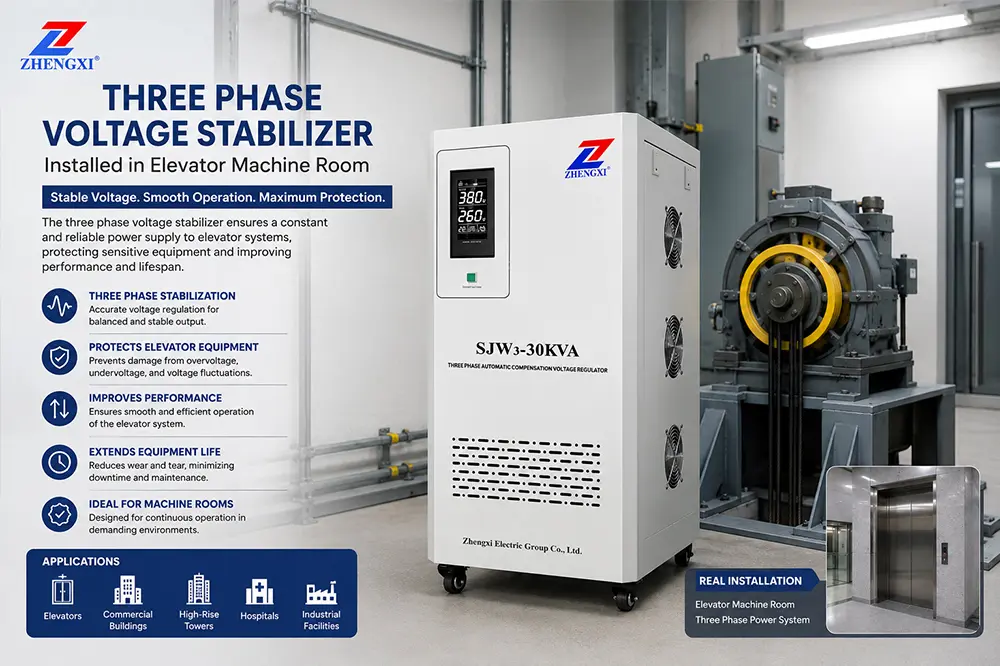
What Is an Elevator AVR?
An elevator AVR (Automatic Voltage Regulator) is electrical equipment designed to maintain stable output voltage regardless of fluctuations in the incoming power supply.
When utility voltage rises above or drops below acceptable limits, the AVR automatically adjusts output voltage to ensure stable operation.
Elevator AVRs commonly protect:
- Elevator motors
- Variable frequency drives (VFDs)
- PLC control systems
- Door control units
- Safety circuits
- Communication modules
- Sensors and monitoring equipment
Without proper voltage stabilization, these components may experience premature failures, nuisance trips, or operational instability.
Why Elevators Need Voltage Stabilization
Elevators are among the most sensitive electrical systems inside modern buildings.
Even relatively small voltage fluctuations can create serious operational problems.
Voltage Sag
Temporary voltage drops may cause:
Voltage Surge
Excessive voltage may result in:
- PCB damage
- Control board failures
- Insulation degradation
- Reduced equipment lifespan
Phase Imbalance
Three-phase voltage imbalance may create:
- Excessive motor current
- Reduced efficiency
- Increased vibration
- Mechanical stress
Frequent Voltage Fluctuations
Buildings located in unstable power grid environments may experience:
- Jerky elevator movement
- Slow response times
- Frequent service interruptions
- Increased maintenance costs
A properly selected voltage stabilizer for elevator systems minimizes these risks.
Common Elevator Problems Caused by Unstable Voltage
Many elevator failures are actually power quality problems rather than equipment failures.
Voltage Sag
- Elevator stalling
- Motor overheating
- VFD trips
- Control resets
Voltage Surge
- PCB damage
- Control board failures
- Insulation degradation
- Shorter lifespan
Phase Imbalance
- Excessive motor current
- Reduced efficiency
- Higher vibration
- Mechanical stress
Frequent Fluctuations
- Jerky movement
- Slow response
- Service interruptions
- Higher maintenance
How a Voltage Stabilizer for Elevator Works
The operating process is straightforward:
- Incoming voltage is continuously monitored
- Voltage abnormalities are detected
- Control circuits calculate correction requirements
- Regulation components adjust output voltage
- Stable power is delivered to elevator equipment
Modern servo and static stabilizers typically achieve output accuracy between ±1% and ±3%.
Types of Elevator Voltage Stabilizers
Servo Voltage Stabilizer
Servo stabilizers use motor-driven regulation transformers to maintain output voltage.
Advantages
- High correction accuracy
- Wide voltage correction range
- Cost-effective solution
- Suitable for continuous operation
Typical Applications
- Passenger elevators
- Residential towers
- Hotels
- Freight lifts
- Commercial buildings
Static Voltage Stabilizer
Static stabilizers regulate voltage using power electronics without moving parts.
Advantages
- Fast response speed
- High efficiency
- Minimal maintenance
Typical Applications
- Hospitals
- High-speed elevators
- Premium buildings
- Critical infrastructure
Servo vs Static Stabilizers: Which Is Better?
| Application | Recommended Type |
|---|---|
| Passenger elevators | Servo AVR |
| Freight elevators | Servo AVR |
| Commercial buildings | Servo AVR |
| High-speed elevators | Static AVR |
| Hospitals | Static AVR |
| Critical facilities | Static AVR |
For most standard elevator applications, servo stabilizers provide the best balance between performance and investment cost.
Why 3 Phase Voltage Stabilizers Are Essential for Lifts
Most modern elevators operate using three-phase power systems.
Therefore, a three-phase voltage stabilizer is usually recommended.
Balanced Three-Phase Output
Maintains equal voltage across phases and prevents motor imbalance.
Protection Against Phase Failure
Advanced systems may detect:
- Phase loss
- Phase reversal
- Phase asymmetry
Improved Motor Performance
Stable voltage helps:
- Reduce starting current
- Improve torque performance
- Extend motor lifespan
Reduced Downtime
Stable power reduces nuisance trips and unexpected failures.
【img】
Alt: Industrial three phase voltage stabilizer protecting elevator systems
Typical Technical Specifications
| Parameter | Typical Range |
|---|---|
| Input Voltage | 300V–480V |
| Output Voltage | 380V / 400V / 415V |
| Regulation Accuracy | ±1% to ±3% |
| Frequency | 50Hz / 60Hz |
| Efficiency | >98% |
| Response Time | <1 second |
| Capacity Range | 10–500kVA |
| Protection Class | IP20–IP54 |
Elevator AVR vs UPS: What’s the Difference?
| Feature | Elevator AVR | UPS |
|---|---|---|
| Voltage Regulation | Yes | Limited |
| Backup Power | No | Yes |
| Continuous Stabilization | Yes | No |
| Surge Protection | Yes | Yes |
| Cost | Lower | Higher |
AVRs stabilize voltage continuously, while UPS systems primarily provide backup power.
Many installations use both systems together.
How to Calculate the Correct AVR Size for an Elevator
Selecting the correct stabilizer capacity is essential.
Use this simplified formula:
Example:
- Motor Power: 10kW
- Starting Factor: 1.5
- Power Factor: 0.8
AVR Capacity ≈ 10 × 1.5 ÷ 0.8 × 2 ≈ 37.5 kVA
Recommended selection:
Choose approximately 40–50kVA stabilizer
Why use ×2?
Because elevator systems experience:
- High starting current
- Dynamic loading
- VFD transient conditions
- Safety margin requirements
Slight oversizing usually improves reliability.
How to Choose the Right Elevator AVR
1. Check Elevator Motor Rating
Evaluate:
- Motor kW
- Motor HP
- Drive capacity
2. Analyze Voltage Conditions
Measure:
- Minimum voltage
- Maximum voltage
- Frequency of fluctuations
3. Verify System Voltage
Common elevator systems include:
- 380V
- 400V
- 415V
4. Consider Future Expansion
Reserve additional capacity if future elevator expansion is planned.
5. Evaluate Protection Functions
Recommended protection functions:
- Over-voltage protection
- Under-voltage protection
- Overload protection
- Short circuit protection
- Phase failure protection
- Surge suppression
Benefits of Installing Elevator AVR
Installing an elevator voltage stabilizer provides:
✓ Reduced elevator downtime
✓ Improved passenger safety
✓ Extended motor lifespan
✓ Better VFD protection
✓ Lower maintenance costs
✓ Improved ride comfort
✓ Increased operational reliability
✓ Higher energy efficiency
For buildings with unstable utility power, voltage stabilization is often one of the most cost-effective investments.
Market Trends Driving Demand for Elevator Voltage Stabilizers
Several trends are increasing market demand:
- Expansion of high-rise buildings
- Growth of smart building infrastructure
- Increasing use of regenerative drives
- Aging utility grids
- Greater dependence on electronic control systems
As elevator systems become more sophisticated, stable electrical power becomes increasingly important.
Conclusion
Modern elevators require more than reliable mechanical systems—they also require stable electrical power.
An elevator AVR helps protect motors, VFD drives, control systems, and sensitive electronics from voltage fluctuations that may lead to expensive failures and operational interruptions.
For most commercial applications, a properly selected three-phase voltage stabilizer provides the most effective solution for maintaining stable operation, reducing downtime, and extending equipment lifespan.
Looking for a Reliable AVR for Lift Applications?
Selecting the correct elevator voltage stabilizer requires more than matching voltage ratings.
Motor starting current, load characteristics, drive compatibility, installation environment, and future expansion should all be considered.
ZHENGXI provides customized servo and three-phase voltage stabilizer solutions for:
- Passenger elevators
- Freight lifts
- Hotels
- Hospitals
- Commercial buildings
- Industrial facilities
Whether you require protection for a single elevator or an entire lift system, our engineering team can help you select the right solution.
Contact us today to discuss your elevator power protection requirements.
FAQ
Most commercial elevators require stabilizers ranging from 15kVA to 100kVA, while large systems may require capacities above 200kVA.
Yes. A properly selected AVR reduces voltage sag, surge, and phase imbalance, helping reduce VFD-related failures.
Most commercial elevators operate using three-phase power and should use three-phase stabilizers.
Yes, provided total load calculations and starting currents are properly considered.
Yes. Stable voltage reduces nuisance trips caused by fluctuating utility power.
High-quality servo stabilizers commonly operate for 10–15 years or longer with proper maintenance.