




In practical power networks, voltage instability is one of the factors that is most frequently observed and at the same time underrated as a cause of equipment failure. Electrical machines malfunction, break down, or even their electronic parts age prematurely, not because of a defective machine or an incorrectly designed system, but because of an unstable voltage supplied to them.
Be it a manufacturing unit, office buildings, healthcare centers, or residential units, the requirement of a constant voltage is immense when it comes to the proper functioning of electrical appliances. Small voltage changes result in unexpected downtime or permanent damage to electrical appliances.
As professional voltage stabilizer and transformer manufacturers, we are often confronted with the following simple but imperative question: What is a voltage stabilizer? This article gives a precise and informative explanation of how voltage stabilizers work, which part of the device they are used in, how they differ from other instruments of a similar type and application, and how you should choose between them.
What Is a Voltage Stabilizer?
A voltage stabilizer, at times called a voltage regulator, is a power conditioning device that is fully capable of automatically regulating voltage to ensure that the voltage remains constant despite fluctuations of the incoming voltage above normal.
In real-world power networks, especially in areas which are developing or industrial, voltage variation is due to the following:
- Variation in Loads during Peak Period
- Radios with long transmission distances
- Large motor startups
- Industrial interference and poor grid regulation
Both overvoltage and undervoltage are hazardous to electrical appliances. A voltage stabilizer is used to monitor the input voltage and regulate it on a constant basis so as to provide the desired constant output voltage to the connected load.
It is a well-established fact in electrical engineering and as per IEEE standards of power quality that voltage regulation is a basic need for protecting sensitive electronic and electromechanical devices.
How Does a Voltage Stabilizer Work?
Despite variations, a closed-loop control system is used in most automatic voltage stabilizers; this system functions as follows:
- Voltage Detection
The incoming supply voltage is constantly monitored by sensors. - Control Circuit Response
When the measured voltage is not in the preset range, the control circuit calculates the amount of correction. - Voltage Adjustment
In the case of different stabilizer models, correction is made by:
Servo motor operated variable transformers
Relay-Based Tap Switch
Solid-state electronic components - Stable Output Supply
The corrected voltage is then transmitted to the load, which happens in milliseconds.
This process is automated and continuous and allows for precise control over the voltage without having to resort to manual controls.

Main Types of Voltage Stabilizers
Servo Voltage Stabilizers
- Servo stabilizers employ a motor-driven system for smooth and precise voltage adjustment.
- Output accuracy (±3%)
- Always suitable for continuous and variable loads.
- Commonly used in CNC machines, elevators, and production lines
Relay Voltage Stabilizers
- Relay Stabilizers function to control voltage by means of transformer taps.
- Cost-effective solution
- Moderate response speed and accuracy
- Typically used in residential and office spaces
Static Voltage Stabilizers
- Their design uses only solid-state components.
- High output accuracy (typically ±1%~±2%)
- No moving parts
- Ultra-fast response time
- It is an ideal component in sensitive electronics, data centers, and healthcare products.
- This is because, in practice, the type of stabilizer to be used is highly dependent on load sensitivity and speed of correction.
Voltage Stabilizers Applications
Voltage stabilizers find their applications across a large number of sectors:
Industrial Applications
Manufacturing and Automation Equipment
CNC machines & Laser cutting systems
Textile, printing and packaging machinery
Control systems for Oil and Gas
Commercial Applications
Data centers and server rooms
Elevators, HVAC systems
Office buildings and shopping malls
Medical Applications
MRI and CT scanners
Laboratory and diagnostic equipment
Life-support and monitoring equipment
Residential Applications
Air conditioners and refrigerators
Home theatres and smart appliances
Industry power quality studies confirm that voltage instability ranks among the most common causes of electrical equipment failure globally.
Voltage Stabilizers in Industrial Power Systems: Manufacturer Insights
From the manufacturer’s point of view, industrial voltage regulators differ significantly from the household variety. Industrial voltage regulators have to function in harsh conditions.
In real-life applications, one common error that takes place in most cases is under-sizing a stabilizer. Starting current, inductive loads, and future enhancement can result in overheating, lag performance, and early failure because these factors may not be taken into consideration. Servo or static stabilizers can be preferred over conventional stabilizers because of smooth voltage compensation and increased longevity for motor-driven and inductive loads.
Main Technical Parameters to Be Taken Into Account
Parameters that are taken into account while rating a voltage stabilizer are:
- Rated Capacity (kVA / kW)
- Input Voltage Range
- Output Voltage Accuracy
- Response Time
- Efficiency (%)
- Phase Configuration (Single-phase / Three-phase)
- Protection Functions (overload, short circuit, over-temperature)
Professional stabilizers usually comply with the IEC and CE standards for power quality.
Voltage Stabilizer vs. Similar Technologies
| Technology | Key Difference |
|---|---|
| UPS | Provides backup power during outages; does not continuously correct voltage |
| Transformer | Changes voltage level but does not actively regulate fluctuations |
| AVR | A voltage regulation function or module, often part of a stabilizer system |
In contrast to transformers and AVRs, a voltage stabilizer is capable of performing a real-time correction of the voltage in a fluctuating power supply.
How to Choose the Right Voltage Stabilizer
The selection of the appropriate voltage stabilizer plays a significant role in its long-run functioning because
Selecting the correct voltage stabilizer is essential for long-term performance:
- Calculate Total Load Capacity
- Include starting current and possible future expansion.
- Understand Grid Conditions
- Unstable grids require wider input voltage ranges.
- Match Equipment Sensitivity
- Precision equipment demands higher accuracy and faster response.
- Consider Installation Environment
- Ambient temperature, humidity, and dust protection all matter.
- Work with an Experienced Manufacturer
- Proper technical evaluation is often more important than initial cost.
Generally, in real-world applications, the selection of the stabilizer is not always “one size fits.
Why Voltage Stabilizers Are Essential Today
Increasing complexity and sensitivity of electric power networks lead to mandatory voltage stabilizers, as these devices become necessity power protection equipment.
A good voltage stabilizer will also help in:
- Minimize unexpected downtime
- Enhance Equipment Life
- Increase operational efficiency
- Reduces Long-Term Maintenance Costs
- As far as engineering and production processes are concerned, stable voltage equals stable operation.
FAQ
Q1: Do I need a voltage stabilizer even though I possess a UPS?
Yes. A UPS is used when there is an outage; it provides power. A voltage stabilizer is used because fluctuations in volts happen very often and not during an outage. It protects the device from constant power shutdowns. It
Q2: Can one voltage stabilizer protect multiple devices?
Yes, as long as the total load is within the rated capacity and the voltage is compatible.
Q3: For how long does the life span of a voltage stabilizer last?
Designed properly, using quality components, and correctly matched for the load, voltage stabilizers in industry can function for 10 to 15 years or longer.
Conclusion
Thus, what is a voltage stabilizer? A voltage stabilizer is an essential component which helps in the management of stable delivery in the event of erratic supplies. Whether installed in Industries, offices, or homes, the importance of a voltage stabilizer in the management of power quality cannot be undermined.
In our own experience as a manufacturer of voltage stabilizers and transformers, we believe a proper understanding of the basics of stabilizers and their selection is the beginning of a good defense.
Related products
-

1000kVA Three-Phase High-Power Intelligent Fully Automatic Non-Contact Static Voltage Stabilizer with LCD Display
-
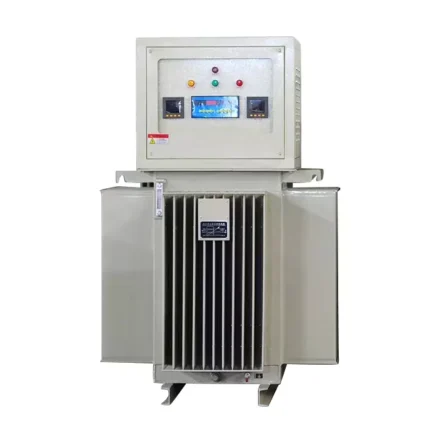
3 phase Oil Immersed AC industrial voltage Stabilizer
-

30KVA Automatic Voltage Regulator for Home & Office Use
-

500va-10Kva Wall-Mounted Voltage Stabilizer for Small Appliances
 EN
EN  FR
FR  ES
ES  PT
PT  IT
IT  RU
RU  AR
AR