



Single Phase IGBT Pure Sine Wave Inverter Voltage Regulator Stabilizer
20KVA Single-Phase Full Automatic AC Voltage Stabilizer AVR For Refrigerator
30KVA Automatic Voltage Regulator for Home & Office Use
Customized Single Phase Wall Mounted 0.5kVA-10kVA Automatic Voltage Stabilizer
The Customized Single Phase Wall Mounted Automatic Voltage Stabilizer is designed to provide reliable voltage regulation and protection for household and commercial electrical appliances. With a power range from 3.5kVA to 10kVA, this wall-mounted stabilizer ensures steady, safe, and efficient power delivery, even in areas with unstable or fluctuating mains voltage.
Built with advanced relay or servo motor control technology, it maintains a constant 220V output by automatically correcting under-voltage or over-voltage conditions. Compact, quiet, and efficient, it’s ideal for homes, offices, and small businesses seeking dependable voltage protection in a sleek wall-mounted design.
Modern washing machines rely on electronic control boards, inverter motors, sensors, and digital displays, which makes them sensitive to unstable power supply. In many regions, household electricity can fluctuate due to grid instability, heavy electrical loads, or weather conditions.
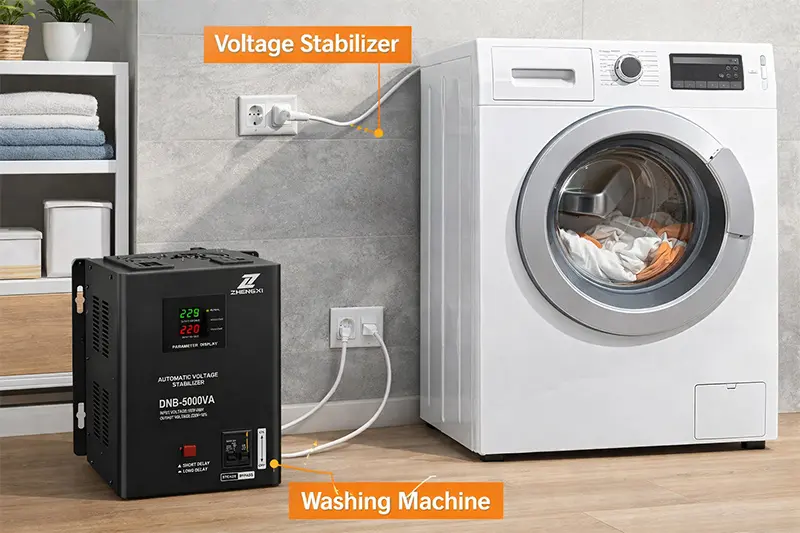
Installing a voltage stabilizer for a washing machine helps ensure that the appliance receives a safe and stable voltage supply, protecting internal electronics and extending the machine’s service life.
This guide explains how washing machine voltage stabilizers work, their applications, technical specifications, and how to choose the right voltage stabilizer for your appliance.
What Is a Voltage Stabilizer for a Washing Machine?
A voltage stabilizer is an electrical device designed to maintain a stable output voltage within a safe tolerance range, even when the input voltage fluctuates.
According to electrical engineering references and power quality research published by the IEEE (Institute of Electrical and Electronics Engineers), voltage fluctuations are one of the most common causes of electronic equipment failure in residential environments.
A washing machine voltage stabilizer is installed between the wall power outlet and the appliance. It continuously monitors the incoming voltage and automatically corrects it to a safe level.
Most washing machines are designed to operate at:
- 220–240 V in many regions (Asia, Europe, Africa)
- 110–120 V in North America
If the supply voltage exceeds this range, it can cause:
- Control board malfunction
- Motor overheating
- Unexpected shutdowns
- Permanent electronic damage
A stabilizer prevents these problems by regulating voltage and protecting the appliance.
Why Washing Machines Need a Voltage Stabilizer
Protection from Voltage Fluctuations
Power grids are not always perfectly regulated. Voltage variations may occur due to:
- High electricity demand in residential areas
- Lightning strikes or storms
- Faulty wiring or transformer imbalance
- Industrial equipment switching on and off
In poorly regulated power networks, voltage may fluctuate from 140 V to over 280 V, exceeding the safe operating range of most household appliances.
According to power quality studies referenced in IEC power supply standards, prolonged voltage fluctuations can significantly shorten the lifespan of electronic equipment.
Protecting Sensitive Electronics
Modern washing machines include several delicate electronic components:
- Microprocessor-based control boards
- Inverter motor drives
- Digital displays and sensors
- Automatic load detection systems
These systems require stable voltage for accurate operation. Even small voltage dips or spikes may cause operational errors or damage electronic circuits.
Using a dedicated appliance voltage stabilizer helps maintain consistent performance and prevents costly repairs.
Extending Appliance Lifespan
Stable voltage improves the reliability of washing machines by:
- Reducing electrical stress on internal components
- Preventing overheating of motors and circuit boards
- Ensuring consistent washing performance
As a result, a voltage stabilizer can significantly extend the lifespan of the appliance and reduce maintenance costs.
Common Applications of Washing Machine Stabilizers
Voltage stabilizers for washing machines are widely used in various environments.
Residential Homes
In many households, stabilizers protect appliances such as washing machines, refrigerators, televisions, and air conditioners.
Apartments and High-Rise Buildings
High-rise residential buildings often experience voltage drops during peak electricity demand, especially in older electrical systems.
Commercial Laundry Facilities
Commercial laundries rely on stable voltage to operate multiple washing machines simultaneously. Voltage stabilizers help prevent downtime and equipment damage.
Rural and Developing Regions
Countries in Asia, Africa, and South America frequently experience power fluctuations, making stabilizers essential for protecting home appliances.
【img】
alt: wall mounted voltage stabilizer used for commercial laundry washing machines
Types of Voltage Stabilizers for Washing Machines
Different stabilizer technologies are available depending on power requirements and accuracy.
Relay-Type Voltage Stabilizer
Relay stabilizers regulate voltage by switching transformer taps using relays.
Advantages:
- Affordable
- Fast voltage correction
- Compact design
They are commonly used for small household appliances and washing machines.
Servo Voltage Stabilizer
Servo stabilizers use a servo motor and carbon brush mechanism to continuously adjust the transformer output.
Advantages:
- High voltage accuracy
- Smooth regulation
- Suitable for higher loads
Servo stabilizers are often used for large appliances or commercial equipment.
Static (Electronic) Stabilizer
Static stabilizers use fully electronic circuits and semiconductor components for voltage regulation.
Advantages:
- Extremely fast response time
- High reliability
- No mechanical wear
They are commonly used in advanced power protection systems.
【img】
alt: internal structure of servo voltage stabilizer with transformer and control circuit
Key Technical Specifications to Consider
When choosing a voltage stabilizer for a washing machine, several parameters should be evaluated.
Stabilizer Capacity (VA Rating)
The stabilizer rating should exceed the washing machine’s power consumption.
Typical washing machine power ranges from 500 W to 1000 W, depending on the model and motor type.
Example calculation:
- Washing machine power: 800 W
- Recommended stabilizer: 1 kVA
Recommended Stabilizer Size
| Washing Machine Power | Recommended Stabilizer |
|---|---|
| 500 W | 1 kVA |
| 800 W | 1 kVA |
| 1000 W | 1.5 kVA |
Choosing a stabilizer with 20–30% extra capacity ensures reliable operation.
Input Voltage Range
Common stabilizer input ranges include:
- 140 V – 260 V (standard models)
- 90 V – 300 V (wide-range stabilizers)
If your area experiences severe fluctuations, a wide input voltage range stabilizer is recommended.
Output Voltage Accuracy
Most stabilizers maintain output voltage at:
220 V ±5%
Stable output voltage ensures proper washing machine operation.
Response Time
Fast response time allows stabilizers to quickly correct voltage fluctuations before they affect sensitive electronics.
Typical response times:
- Relay stabilizer: 10–20 ms
- Static stabilizer: <5 ms
Protection Features
High-quality stabilizers include multiple protection functions:
- Over-voltage protection
- Under-voltage protection
- Overload protection
- Thermal protection
- Surge protection
These features improve safety and appliance reliability.
Built-In Stabilizer vs External Voltage Stabilizer
Some modern washing machines claim to include built-in voltage protection, but these systems have limitations.
| Feature | Built-in Protection | External Stabilizer |
|---|---|---|
| Voltage correction range | Limited | Wide |
| Surge protection | Basic | Advanced |
| Equipment lifespan | Moderate | Higher |
| Suitable for unstable grids | Not always | Yes |
According to power equipment manufacturers such as Schneider Electric and ABB, external voltage stabilizers provide more reliable power regulation for household appliances in unstable grid environments.
【img】
alt: modern digital voltage stabilizer for washing machine with LED display
How to Choose the Right Stabilizer for a Washing Machine
When selecting a stabilizer, follow these steps.
1. Check the Washing Machine Power Rating
Look at the specification label on the appliance. Most machines consume 500–1000 W.
2. Choose the Correct Stabilizer Capacity
Select a stabilizer with 120–150% of the appliance power rating.
Example:
- 800 W washing machine
- Recommended stabilizer: 1 kVA
3. Select the Appropriate Voltage Range
If your area experiences unstable electricity supply, choose a wide input range stabilizer.
4. Consider Installation Type
Common installation options include:
- Plug-and-play stabilizers
- Wall-mounted stabilizers
- Multi-appliance stabilizers
5. Verify Safety Certifications
Reliable stabilizers comply with international standards such as:
- IEC electrical safety standards
- CE certification
- ISO quality management systems
FAQ
Many modern washing machines include basic voltage protection circuits, but they cannot handle severe voltage fluctuations. An external stabilizer provides stronger protection and wider voltage correction range, especially in regions with unstable electricity supply.
Most household washing machines require a stabilizer rated 1 kVA to 1.5 kVA, depending on the power consumption and motor type.
Yes, but the stabilizer must have sufficient capacity. However, using a dedicated voltage stabilizer for a washing machine provides faster response and better protection.
Conclusion
A voltage stabilizer for washing machines is an effective solution for protecting modern appliances from unstable power supply. By maintaining stable voltage, stabilizers prevent electronic damage, improve washing machine performance, and extend equipment lifespan.
Whether used in homes, apartments, commercial laundries, or regions with unstable power grids, choosing the right stabilizer based on capacity, voltage range, and protection features ensures reliable appliance operation and long-term cost savings.