




As global demand for renewable energy continues to rise, solar photovoltaic (PV) systems are being widely deployed across residential, commercial, and utility-scale applications. However, one of the most critical technical challenges in these systems is maintaining stable voltage under highly variable operating conditions.
A Voltage Stabilizer for PV Systems—also known as a Solar Voltage Stabilizer, PV Voltage Regulator, or Bidirectional Voltage Stabilizer—plays a crucial role in ensuring stable power delivery, protecting electrical equipment, and improving overall grid compatibility.
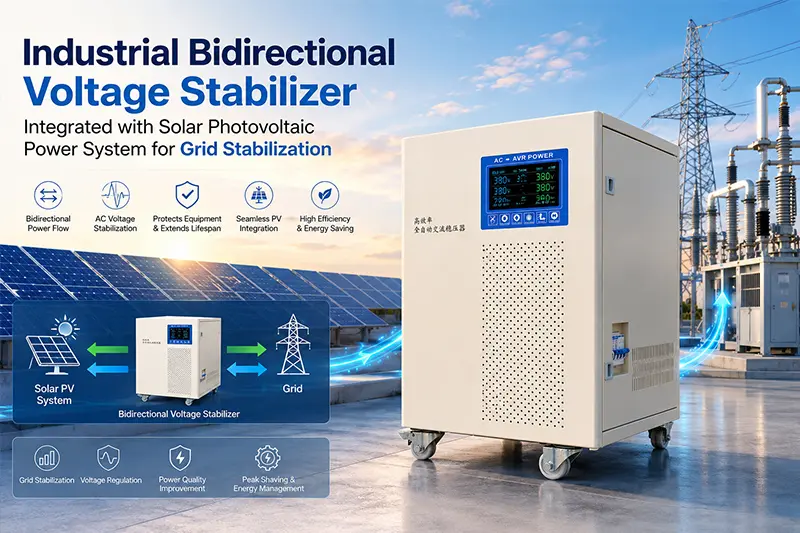
This article explains how PV voltage stabilizers work, where they are used, key technical considerations, and why they are becoming increasingly important in modern renewable energy infrastructure.
What Is a Voltage Stabilizer for PV Systems?
A PV voltage stabilizer is an advanced electrical regulation device designed to maintain a stable output voltage despite fluctuations caused by solar generation variability or grid instability.
Unlike conventional stabilizers, a modern Bidirectional Voltage Stabilizer can regulate power flow in both directions:
- From grid to load
- From solar PV system back to grid or load
This bidirectional capability is essential in systems that integrate solar PV, energy storage, and smart grid infrastructure.
Core Functions
- Automatic voltage regulation (AVR)
- Overvoltage and undervoltage protection
- Power quality stabilization
- Equipment protection for sensitive loads
- Grid compliance support based on utility standards
Why Voltage Stability Matters in Solar PV Systems
Solar power generation is inherently intermittent. Voltage fluctuations are influenced by environmental and operational factors such as:
- Solar irradiance variations
- Cloud cover and shading effects
- Ambient temperature changes
- Grid instability and weak networks
- Sudden load variations
- Long-distance transmission line impedance
Maintaining voltage within acceptable limits is essential for safe and efficient grid operation.
Without proper voltage regulation, PV systems may suffer from:
Frequent inverter tripping
Energy production losses
Reduced system efficiency
Accelerated equipment aging
Grid non-compliance issues
Alt: Solar inverter disconnecting from grid due to voltage instability in a photovoltaic installation
Bidirectional Voltage Regulator: The Modern Solution for Solar Energy Systems
A Bidirectional Voltage Regulator is specifically engineered for renewable energy environments where energy flows dynamically between multiple sources and loads.
Traditional vs Bidirectional Operation
Traditional Stabilizer:
Grid → Stabilizer → Load
Bidirectional Stabilizer:
Grid ↔ Stabilizer ↔ PV System ↔ Load
This architecture allows real-time voltage correction regardless of power flow direction, making it ideal for grid-tied solar systems and hybrid energy storage applications.
Advantages
A Bidirectional Voltage Regulator is specifically engineered for renewable energy environments where energy flows dynamically between multiple sources and loads.
Supports grid-tied and off-grid hybrid systems
Compatible with Battery Energy Storage Systems (BESS)
Improves inverter operational stability
Handles reverse power flow efficiently
Enhances grid resilience and reliability
How a Solar Voltage Stabilizer Works
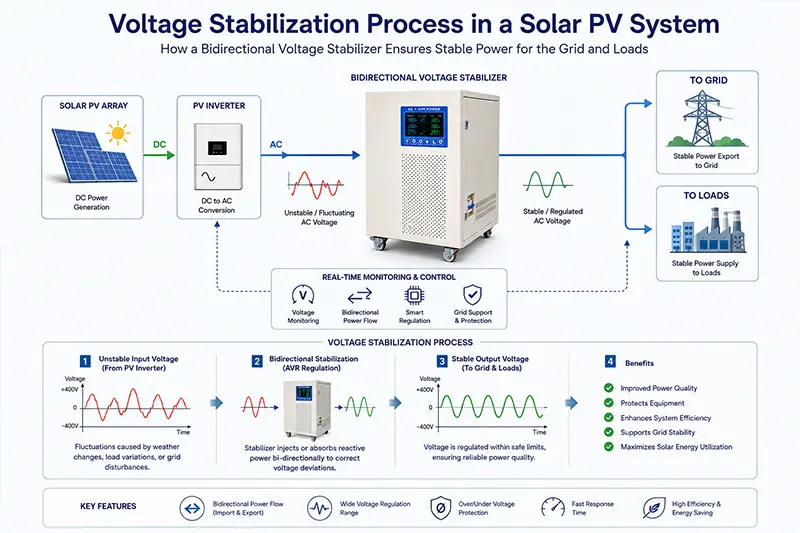
A modern solar stabilizer uses advanced sensing and control algorithms to continuously monitor and regulate system voltage.
Real-Time Monitoring
The system continuously measures grid voltage, PV inverter output voltage, and load-side voltage conditions.
Intelligent Analysis
A digital controller compares real-time values with preset safety thresholds.
Automatic Regulation
If voltage drops, boost operation is activated. If voltage rises, buck operation is activated.
Continuous Feedback Loop
The system performs dynamic adjustments to maintain stable output voltage.
Applications of PV Voltage Stabilizers
Utility-Scale Solar Farms
Maintain grid compliance and reduce curtailment caused by voltage rise.
Commercial & Industrial Facilities
Improve equipment reliability and minimize downtime risks.
Residential Solar Systems
Protect household appliances and improve inverter stability.
Energy Storage Systems
Support stable operation under bidirectional power flow conditions.
Microgrids
Provide precise voltage control for distributed energy resources.
Market Trends Driving Demand
The global PV industry continues to expand rapidly. According to the International Energy Agency (IEA), solar energy remains one of the fastest-growing renewable sources worldwide.
Key market drivers include:
- Increasing PV penetration in distribution grids
- Rapid adoption of energy storage systems
- Smart grid modernization initiatives
- Tighter grid compliance regulations
- Growing industrial electrification demand
Technical Parameters of PV Voltage Stabilizers
| Parameter | Specification Range |
|---|---|
| Capacity | 10 kVA – 5000 kVA |
| Output Accuracy | ±1% to ±3% |
| Efficiency | Up to 98% |
| Response Time | Milliseconds to seconds |
| Cooling System | Air / Oil cooled |
| Protection Class | IP20 – IP54 |
| Communication | RS485 / Modbus / Ethernet |
Bidirectional vs Conventional Voltage Stabilizers
| Feature | Conventional | Bidirectional |
|---|---|---|
| Power Flow | One-way | Two-way |
| Solar Compatibility | Limited | Advanced |
| Battery Support | No | Yes |
| Grid Export Control | No | Yes |
| Smart Grid Ready | Partial | Full |
How to Select the Right PV Voltage Regulator
System Capacity
Choose 20–30% margin above peak load.
Voltage Variation Range
Evaluate minimum and maximum fluctuations.
Future Expansion
Consider future battery and PV upgrades.
Grid Compliance
Follow local utility regulations.
Environmental Conditions
Assess temperature, dust, and humidity requirements.
Key Benefits
- Higher solar energy utilization
- Reduced inverter shutdowns
- Extended equipment lifespan
- Improved power quality
- Lower maintenance costs
- Enhanced grid compliance
Future Trends in Voltage Regulation Technology
Future PV voltage stabilizers are evolving toward intelligent energy management systems featuring:
- AI-based voltage control algorithms
- IoT-enabled remote monitoring
- Smart grid integration
- Digital twin energy modeling
- DERMS (Distributed Energy Resource Management Systems)
Conclusion
A Voltage Stabilizer for PV Systems is becoming a critical component in modern renewable energy infrastructure. Whether referred to as a Solar Voltage Stabilizer or Bidirectional Voltage Regulator, its role in maintaining voltage stability, improving system efficiency, and ensuring grid compliance is essential.
For solar farms, commercial facilities, and hybrid energy systems, advanced voltage regulation technology ensures long-term reliability and optimized energy performance.
FAQ
1. What is the difference between a PV inverter and a voltage stabilizer?
A PV inverter converts DC power to AC power, while a voltage stabilizer ensures that AC voltage remains stable and within safe operating limits.
2. Why is bidirectional voltage regulation important?
Because modern energy systems involve two-way power flow between solar, storage, and grid, bidirectional regulation ensures stability under all operating conditions.
3. Does a voltage stabilizer improve solar efficiency?
Indirectly yes. By preventing inverter shutdowns caused by voltage instability, it improves overall energy harvesting efficiency.
Recommended Products

20KVA Single-Phase Full Automatic AC Voltage Stabilizer AVR For Refrigerator
Customized Single Phase Wall Mounted 0.5kVA-10kVA Automatic Voltage Stabilizer
The Customized Single Phase Wall Mounted Automatic Voltage Stabilizer is designed to provide reliable voltage regulation and protection for household and commercial electrical appliances. With a power range from 3.5kVA to 10kVA, this wall-mounted stabilizer ensures steady, safe, and efficient power delivery, even in areas with unstable or fluctuating mains voltage.
Built with advanced relay or servo motor control technology, it maintains a constant 220V output by automatically correcting under-voltage or over-voltage conditions. Compact, quiet, and efficient, it’s ideal for homes, offices, and small businesses seeking dependable voltage protection in a sleek wall-mounted design.
People Avr Series 0.5Kva-10Kva Single Phase Automatic Voltage Stabilizer For Home