In today’s world, modern electrical equipment, which is employed in industries, healthcare facilities, data centers, or commercial spaces, depends on dependable, clean, and precisely regulated voltages, but in reality, electricity grid conditions can vary significantly in terms of the region, load, or operating surroundings.
This explains the rationale behind making customizations to the voltage stabilizer, which is more likely to succeed than choosing an off-the-shelf product.
With reference to practical application in engineering, the document will provide users with a clear explanation of how to make a voltage stabilizer customization according to their needs, including relevant technical parameters, application examples, as well as selection recommendations from professional vision.
What Does “Voltage Stabilizer Customization” Really Mean?
A voltage stabilizer must, therefore, automatically maintain the output voltage within a specified limit, considering the fluctuation in the input supply.
It is much more than that-it means redesign of the electrical design, control logic, protection strategy, and mechanical structure of the stabilizer to meet your application’s actual operating conditions.
A properly customized stabilizer takes into consideration:
As reported by IEEE guidelines on power quality, voltage deviation above ±5% may greatly reduce the equipment service life, which regards highly motor, medical systems, and power electronics.
Why Standard Voltage Stabilizers Are Often Not Enough
The usual standard stabilizers are developed with an aim of working within “average” conditions; however, most projects do not
Some of its usual constraints might include:
Fixed input voltage range that doesn’t match local grid behavior Generic protection settings Response time too slow on equipment requiring it Poor performance in harmonic-rich environments
For example, in computer numerical control equipment, such as MRI scanners and laser cutting equipment, as well as in automatic production equipment, it is frequently necessary to provide a regulation accuracy of better than 1%. However, such accuracy cannot be provided by most conventional stabilizers.
Key Parameters to Customize in a Voltage Stabilizer
3.1 Input Voltage Range (Based on Real Grid Data)
The first step in customization is analyzing actual voltage fluctuations on site, not just nominal values.
Typical scenarios include:
Rural or unstable grids: wide input range (e.g. 140–280V)
Industrial zones: frequent voltage dips during motor starting
Renewable-integrated grids: fast and irregular voltage swings
A customized stabilizer is designed to operate continuously without frequent bypass or shutdown, even under extreme conditions.
3.2 Output Voltage Accuracy
Different equipment tolerates different voltage deviations:
Equipment Type
Recommended Accuracy
Medical devices
±1%
CNC machines
±1–2%
HVAC systems
±3%
Lighting systems
±5%
High-precision applications usually require servo-controlled or static (IGBT-based) voltage stabilizers, rather than relay-based designs.
3.3 Capacity (kVA / kW Rating)
Capacity selection is one of the most common failure points.
A customized design considers:
Rated operating load
Starting current (especially for motors and compressors)
Load diversity
Future expansion margin (typically 20–30%)
Engineering practice based on IEC and IEEE recommendations shows that undersized stabilizers lead to overheating and premature failure, while oversized units reduce efficiency and increase unnecessary costs.
3.4 Load Type & Harmonics
Modern equipment such as VFDs, UPS systems, servers, and inverters introduces harmonics into the power system.
For semiconductor equipment, laboratories, or automation lines, static or hybrid solutions are often the only reliable choice.
Application-Specific Customization Scenarios
4.1 Industrial Manufacturing
Key challenges include:
High inrush currents
Continuous 24/7 operation
Dust, heat, and vibration
Typical customization features:
Forced-air or oil cooling
IP54 / IP65 enclosures
PLC or SCADA communication interfaces
4.2 Medical & Healthcare Facilities
Medical equipment demands absolute reliability.
Customized stabilizers often include:
Redundant control circuits
Medical-grade isolation
Low noise operation
Compliance with IEC medical power standards
4.3 Data Centers & IT Infrastructure
Voltage stabilizers are often installed upstream of UPS systems to reduce stress and improve overall efficiency.
Customization focuses on:
Tight voltage regulation
High efficiency at partial loads
Compact footprint
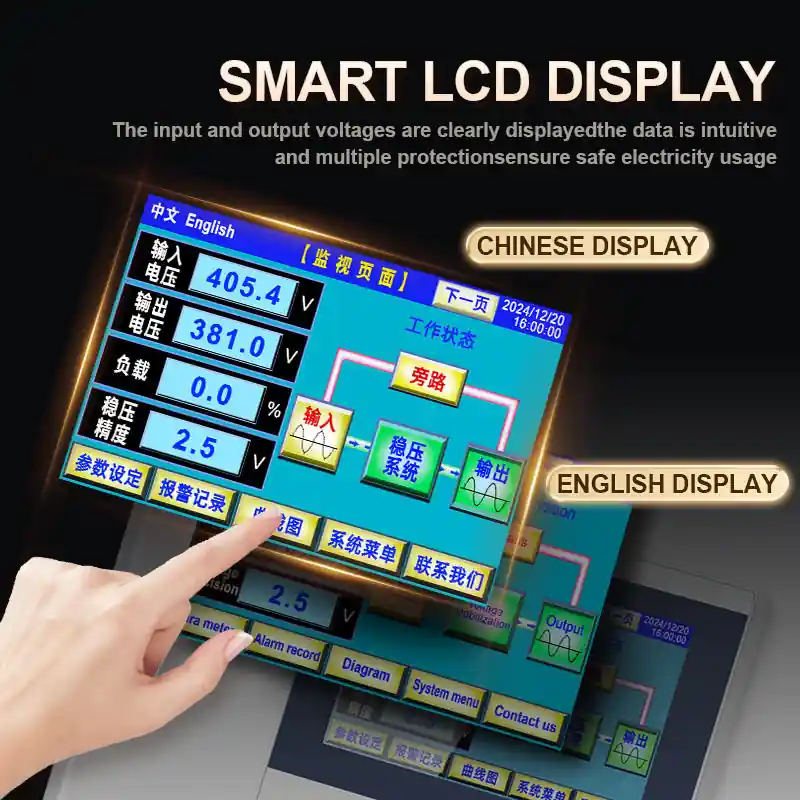
Remote monitoring and alarms
4.4 Commercial & Residential Buildings
For elevators, HVAC systems, and lighting, customization emphasizes:
Cost optimization
Energy efficiency
Low acoustic noise
Aesthetic enclosure design
Market Trends Driving Customized Voltage Stabilizers
There are a number of global trends driving up demand for customized products and services, including:
Grid instability in emerging markets
Rapid growth of automation and Industry 4.0
High Penetration of Renewable Energy
Stricter power quality requirements
Industry information, consulted by IEEE, states that there are steady growth rates in Asia, Africa, and even the Middle East, where grid conditions are varied.
6. Customized vs. Standard Voltage Stabilizers
Aspect
Standard Stabilizer
Customized Stabilizer
Input range
Fixed
Site-specific
Accuracy
General
Application-optimized
Protection
Basic
Advanced & tailored
Lifespan
Average
Extended
Total cost
Lower upfront
Lower TCO
While customization may involve higher initial cost, total cost of ownership is usually lower due to reduced downtime and longer service life.
7. How to Choose the Right Manufacturer for Customization
When selecting a manufacturer for customized voltage stabilizers, look for:
Proven factory and manufacturing capability
Compliance with IEC / IEEE standards
In-house engineering and testing teams
Custom design and simulation support
Real project references
Large global brands set design benchmarks, but experienced OEM manufacturers often provide more flexible, application-specific solutions.
8. Professional Buying Checklist
Before requesting a customized stabilizer, prepare:
Input voltage data (min / max / frequency)
Load details (kW, kVA, power factor)
Equipment sensitivity
Installation environment
Required certifications and standards
Close collaboration with the manufacturer’s engineering team ensures the stabilizer is designed, tested, and validated for real operating conditions.
9. FAQ
Q1: Is a customized voltage stabilizer worth the extra cost? Yes. For sensitive or mission-critical equipment, customization significantly reduces failure risk and maintenance costs.
Q2: How long does customization take? Typically 2–6 weeks, depending on capacity, control complexity, and certification requirements.
Q3: Can existing stabilizers be upgraded? In some cases, control and monitoring systems can be upgraded, but full customization is most effective when designed from the start.
10. Final Thoughts
Customizing a voltage stabilizer is not just a technical decision—it is a strategic investment in equipment protection, operational reliability, and long-term efficiency.
As power quality challenges continue to grow, tailored voltage regulation solutions are becoming the norm rather than the exception, especially for industrial and critical applications.
In modern industrial power systems, voltage stability is a fundamental requirement rather than an optional feature. Unstable three-phase voltage can directly lead to equipment shutdowns, control system faults, motor overheating, and long-term damage to mechanical machinery.
The SBW Industrial Outdoor 100KVA 3 Phase Servo Automatic Voltage Stabilizer, manufactured by ZHENGXI, is specifically designed to provide precise and reliable voltage regulation for heavy-duty mechanical equipment operating in unstable or fluctuating grid environments. With servo motor control technology and a rugged outdoor structure, this three phase stabilizer ensures continuous, safe, and efficient industrial operation.
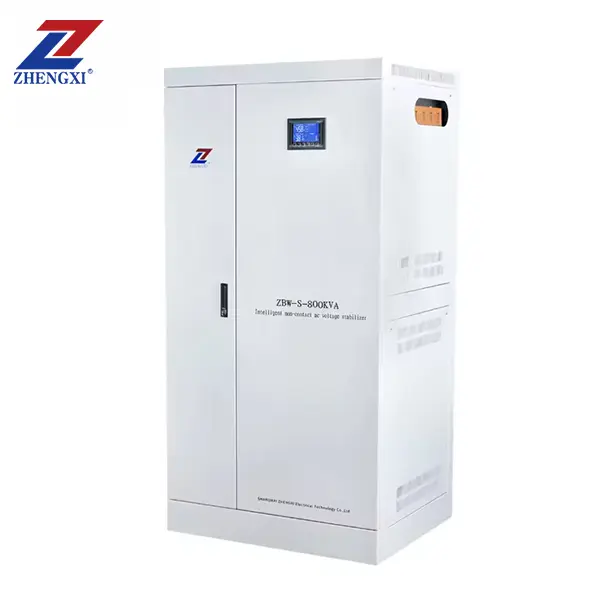
1000kVA Three Phase Intelligent Fully Automatic Non-Contact Static Voltage Stabilizer by ZHENGXI is designed to counteract such problems in high-load, high-precision, and fluctuating environments.
This stabilizer utilizes advanced microprocessor control for static compensation and offers rapid action, super high efficiency, and non-contact regulation. This product will ensure stable power with its efficient performance.
ZBW 10Kva-4000Kva 3 phase igbt static automatic voltage stabilizer for High-Precision Machines
Voltage stability in modern industrial setups is no longer a luxury but an imperative requirement for precision, efficiency, and longevity. The ZBW Series 3 Phase IGBT Static Automatic Voltage Stabilizer, with capacities ranging from 10kVA to 4000kVA, manufactured by ZHENGXI, is specifically designed for precise, accurate, and distortion-free voltage regulation for high-precision machines when dealing with unstable power conditions.
The ZBW Stabilizer, which uses cutting-edge technology in IGBT Static Control, will provide a stable output voltage even when there are significant fluctuations in the input power, making this a very reliable and efficient device especially for industries with minimal shutdown times.
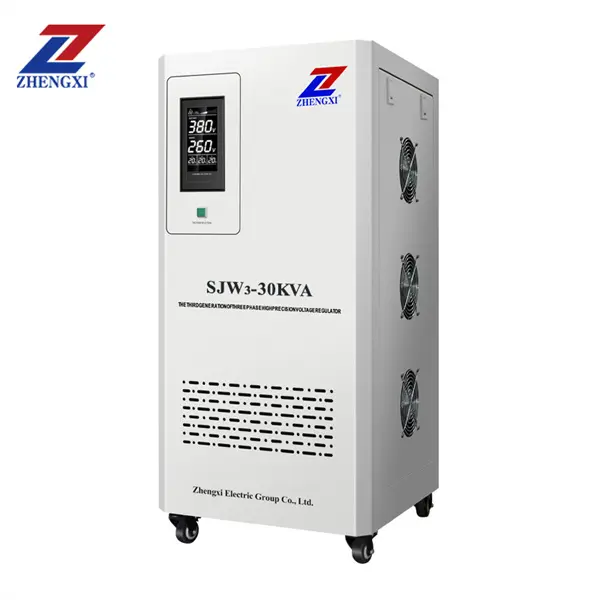
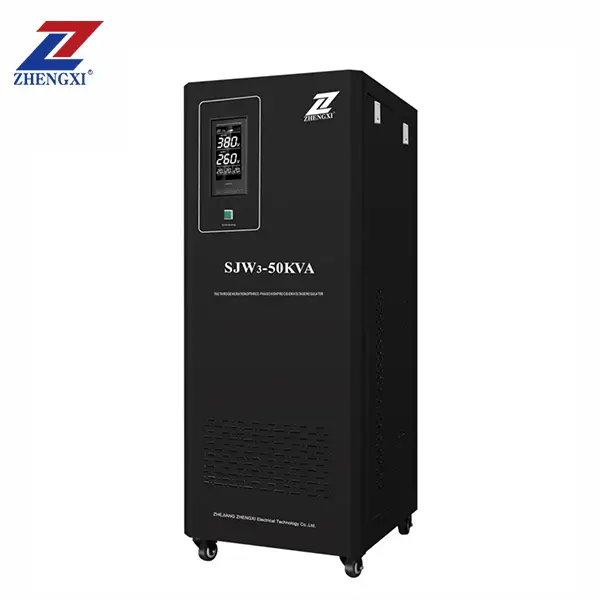
The SJW 3 Phase 40KVA Servo Voltage Stabilizer is designed to deliver clean, stable, and reliable power for commercial facilities and modern data centers. With its high-accuracy ±3% voltage correction, servo motor control, and real-time digital monitoring, it ensures uninterrupted performance for sensitive IT loads, servers, networking equipment, and precision industrial electronics.
Built for 24/7 continuous operation, this stabilizer helps reduce equipment failure, prevent downtime, and extend the lifespan of mission-critical systems. For organizations that rely on stable power—data centers, telecom rooms, financial institutions, security monitoring hubs, hospitals, and manufacturing lines—SJW stabilizers provide a long-term, high-efficiency power protection solution.